




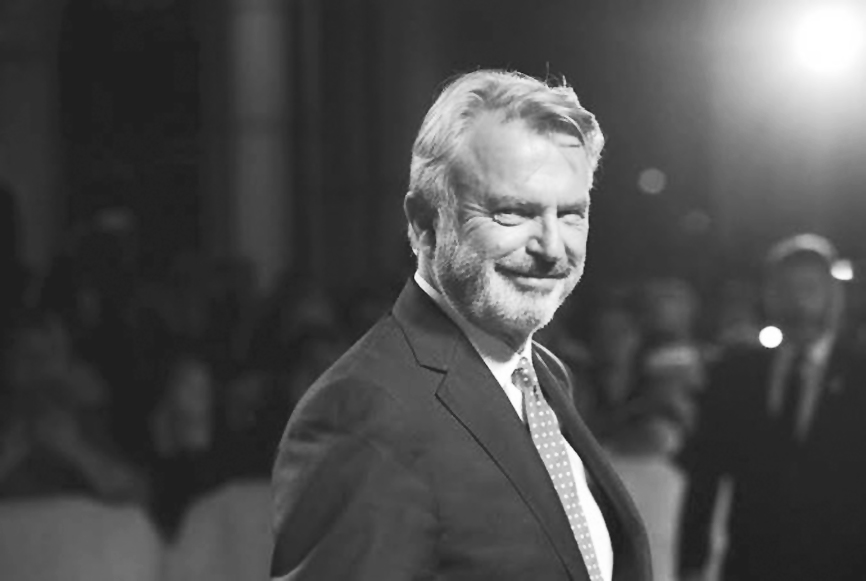
A tribute to Sir Sam Neill and Dr Alan Grant, exploring how humility, knowledge and quiet competence remain vital in an age of AI, social media and noise.
THERE are two kinds of people in Jurassic Park. The first is convinced they can control dinosaurs with enough money, technology and confidence. The second quietly looks at a claw mark on a tree, sighs and says: “We’re in trouble.”
I have always wanted to be the second person.
When news broke that Sir Sam Neill had passed away earlier this month, I realised I wasn’t simply mourning an actor. I was saying goodbye to one of cinema’s greatest examples of quiet competence. For many of us, he wasn’t Sam Neill; he was Dr Alan Grant – the dusty palaeontologist who somehow became the calmest man in the middle of absolute chaos.
Think about it. Hollywood usually tells us heroes are billionaires in iron suits, spies with impossible gadgets or muscle-bound men who never seem to sweat. Grant’s superpower? He read books, brushed dirt off fossils and wore a hat that looked like it had survived several monsoons.
Yet, when genetically engineered dinosaurs decided humans were no longer at the top of the food chain, guess who everyone followed? Not the billionaire who built the park. Not the mathematician who predicted disaster. Not the lawyer who spent more time worrying about lawsuits than survival. They followed the palaeontologist. Perhaps that is because real heroes rarely announce themselves.
We are living in an era where confidence is often mistaken for competence. Social media has convinced us that speaking the loudest somehow makes us the smartest. Everyone is an expert after watching three TikTok videos and reading half a Facebook post. Alan Grant would have hated that.
He didn’t pretend to know everything. In fact, one of his greatest strengths was admitting when he didn’t. Scientists call it curiosity. The internet calls it weakness.
We have somehow reached a point where changing your mind after seeing new evidence is considered a flaw. Grant would call it learning. Maybe that is why his character still feels so refreshing more than three decades later.
He wasn’t trying to become famous. He wasn’t building a personal brand. He wasn’t chasing followers. He simply loved dinosaurs. Imagine that, having a personality that isn’t carefully curated for likes.
Even funnier was his relationship with children. At the beginning of the film, Grant made it abundantly clear that children weren’t exactly his favourite species. He would rather spend weeks in a desert digging up a 70-million-year-old fossil than entertain a noisy eight-year-old.
By the end of the film, after surviving several carnivorous encounters while protecting two children, he discovers something unexpected about himself. Life has a funny way of changing our minds.
Most of us have had our own Grant moments. The colleague we judged too quickly becomes the one who saves a project at the eleventh hour.
The job we swore we would never enjoy becomes our calling. The child we thought we couldn’t understand becomes the person who teaches us the most. Growing older isn’t about having all the answers; it is about becoming comfortable with rewriting them.
There is another reason I admire Grant. He respected nature. While everyone else marvelled at the spectacle of bringing dinosaurs back to life, Grant never stopped asking whether they should have done it in the first place. That question feels more relevant today than ever.
Artificial intelligence writes essays. Algorithms decide what we read. Technology is moving faster than our ability to understand its consequences.
Every week brings another invention that promises to change humanity forever. Progress is exciting. But perhaps every boardroom needs an Alan Grant, someone willing to ask the awkward questions before everyone starts applauding.
Just because we can doesn’t always mean we should. Malaysia could use a few Grants too. Not just in laboratories or universities but in our offices, classrooms, hospitals and Parliament.
People who do their homework before speaking. People who value facts over popularity. People who listen more than they lecture. People who don’t need to remind everyone they are the smartest person in the room because everyone else already knows.
Those people rarely trend, rarely go viral and rarely become influencers. But when everything goes spectacularly wrong, they are usually the first people we call.
Perhaps that is why Sam Neill’s performance has endured for generations. He didn’t play a superhero. He played something far more believable – an ordinary man who relied on knowledge, humility and decency when the world fell apart. And maybe that is what we have been missing. In a culture that celebrates noise, perhaps the real revolution is quiet competence.
So here’s to Sir Sam Neill, whose Grant reminded us that wisdom doesn’t need a spotlight, courage doesn’t need a catchphrase and intelligence doesn’t have to shout.
Because if history or Jurassic Park has taught us anything, it’s this: When the dinosaurs start running, follow the scientist. Not the man who built the park.
Hashini Kavishtri Kannan is the assistant news editor at theSun. Comments: [email protected]



