




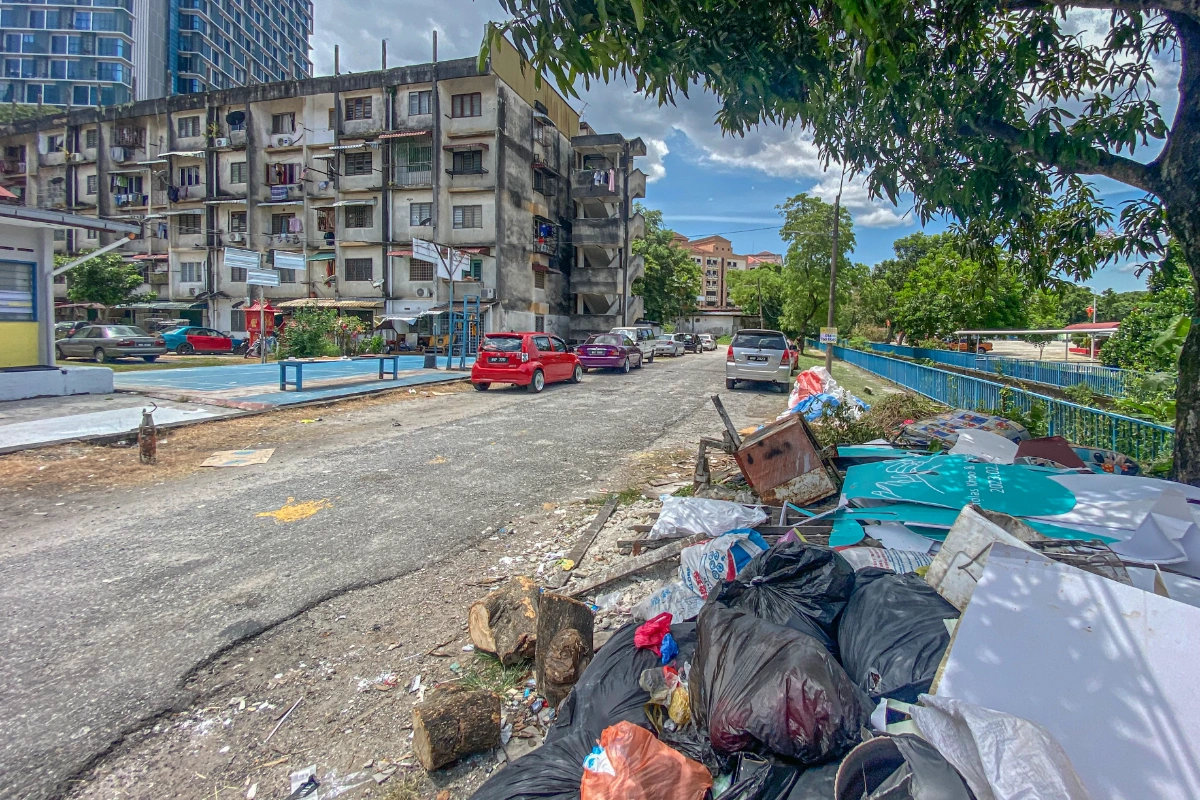
Broken lifts and poor sanitation create disease breeding grounds, proving health relies on more than just medical care.
EVERY week for the past few years, I made the same journey from Universiti Malaya to numerous People’s Housing Programme (PHP) communities across the Klang Valley, where much of my research took place.
It never took long. Yet, every trip reminded me that distance is not always measured in kilometres. Within minutes, the familiar skyline of modern Kuala Lumpur gave way to ageing apartment blocks, where peeling paint, crowded corridors and overworked facilities formed part of everyday life. The gleaming towers that have come to symbolise the nation’s progress were still nearby but here they seemed to belong to another world.
I first came to these communities to study two infectious diseases: dengue and intestinal parasitic infections. At first glance, they appeared to have little in common. One is transmitted by mosquitoes while the other spreads through contaminated food, water and poor sanitation.
Yet, after years of fieldwork, interviews and data collection, I began to see a connection that extended far beyond biology. Both diseases thrive under the same social and environmental conditions.
Overcrowded living spaces, poor environmental sanitation, inadequate waste management and ageing housing infrastructure create an environment where disease persists.
The more time I spent in these communities, the more I realised that I was not simply studying infections; I was studying the conditions that allow them to flourish.
One experience has remained with me throughout this journey. In one apartment block, the lift had broken down – yet again. Residents living on the upper floors had to decide whether to carry heavy bags of rubbish down several flights of stairs or leave them outside their units until they found the time and energy to make the trip.
It is easy to see this as a maintenance problem but much harder to recognise how quickly it can become a public health issue.
When rubbish accumulates in corridors and common spaces, it attracts rodents, stray animals and insect pests. Rainwater collects in discarded containers, creating breeding grounds for mosquitoes. Before long, a faulty lift is no longer just about inconvenience. It becomes part of a chain of events that quietly shapes the health of an entire community.
That was perhaps the most important lesson my research taught me. Health is influenced by far more than hospitals, clinics or medicines. Long before someone visits a doctor, their health has already been shaped by the condition of their homes, the cleanliness of their surroundings, the reliability of basic services and the opportunities available to them.
Malaysia has made remarkable progress in improving healthcare and reducing the burden of many infectious diseases.
Public housing initiatives, clean water, sanitation programmes and accessible healthcare have transformed the lives of many low-income families. These achievements deserve recognition.
Yet, providing affordable housing is only the beginning. Keeping communities healthy requires sustained investment in maintaining the environment people live in long after the buildings are completed.
This has also changed the way I think about poverty. Too often, we reduce poverty to household income or assume that people remain poor because they have made poor choices. However, the late Syed Hussein Alatas reminded us decades ago that poverty is deeply rooted in structural inequalities rather than personal failings. Good health, like opportunity itself, is shaped by systems that individuals cannot always control.
Malaysian literature has long understood this reality. In “Ranjau Sepanjang Jalan”, Shahnon Ahmad portrayed Lahuma not as a man lacking determination but as someone constantly negotiating forces much larger than himself. His struggle reminds us that hardship is rarely the result of character alone. More often, it reflects the circumstances within which people are expected to survive.
The residents I met throughout my research reinforced that lesson. They cared deeply about their families and wanted clean, safe environments for their children. Many did what they could with the resources available to them. Yet, there is only so much they can accomplish when lifts remain broken, waste collection is inconsistent or ageing infrastructure struggles to keep pace with the needs of a growing community.
These experiences have fundamentally changed how I think about public health. Before asking why people behave in certain ways, we should first ask what barriers stand in their way.
It is easy to judge choices without recognising the circumstances that shape them. It is far more difficult – but far more meaningful – to understand the context in which those choices are made.
Every journey back to the university offered the same view of Kuala Lumpur’s impressive skyline. The buildings had not changed and neither had the PPR communities I had just left. What had changed was my understanding of health.
I began this research believing that I was studying dengue and intestinal parasitic infections. I completed it realising that I had been studying something much larger: the environments that shape people’s chances of living healthy lives.
A house may provide four walls and a roof but it takes much more than brick and mortar to build a healthy community.
In the end, that was my greatest lesson: life is about much more than four walls and a roof.
Nabila Abu Bakar is a final-year PhD candidate at Universiti Malaya. Her research is centred around neglected tropical diseases among PHP residents in Klang Valley, Malaysia. Comments: [email protected]



