




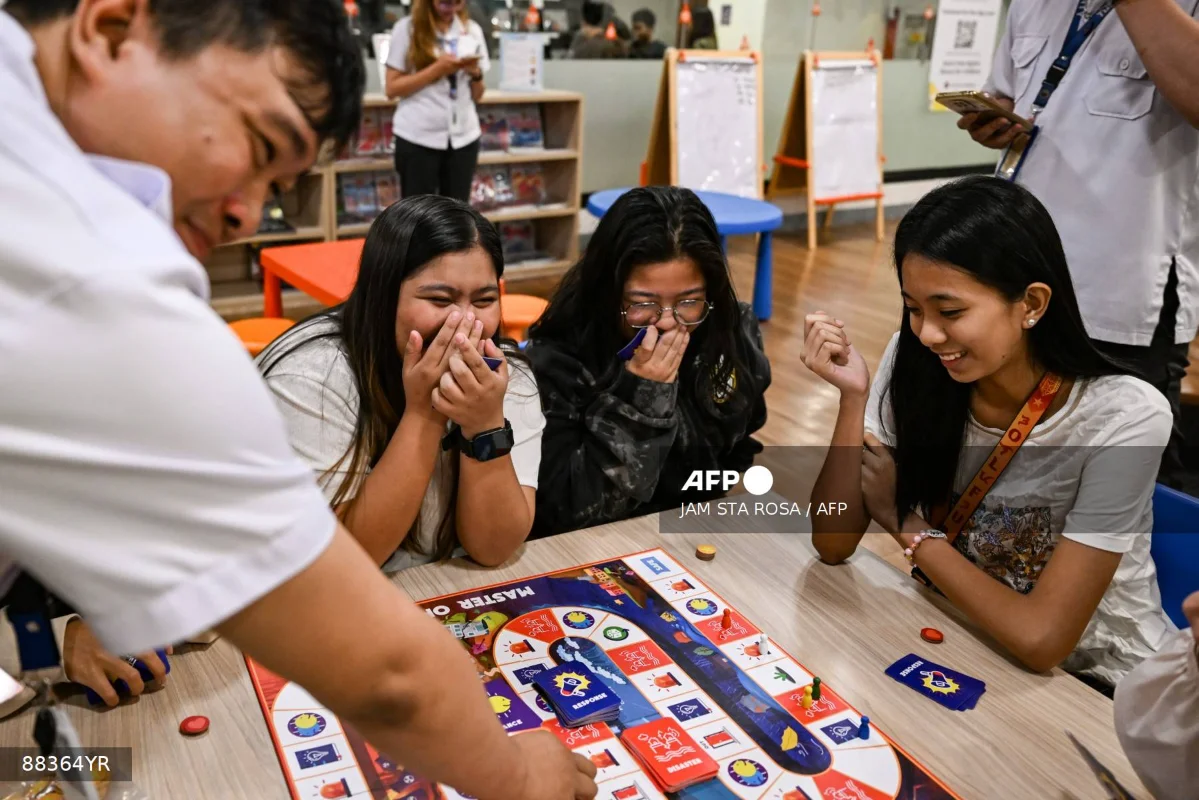
A board game called Master of Disaster is teaching Filipino youth how to prepare for typhoons, quakes and floods in the world’s most disaster-prone country
MANILA: Teenagers in a Philippine library are learning to survive typhoons and earthquakes by rolling dice.
They are playing a board game called Master of Disaster, designed to boost lagging preparedness in a country ranked the world’s most disaster-prone for four consecutive years.
The game features real-life catastrophes like the flooding that routinely hits player Ansherina Agasen’s hometown north of Manila.
Sitting in the seismically active “Pacific Ring of Fire”, the Philippines endures daily earthquakes and about 20 typhoons annually.
Back-to-back typhoons killed nearly 300 people in November, while a September quake killed 79 around Cebu.
Developer Francis Macatulad said the game was created because many lives and properties could be saved with better preparedness knowledge.
His organisation, ASSIST, first conceived the game after Super Typhoon Haiyan ravaged the central Philippines in 2013.
Launched in 2019, the game has been updated this year to address climate change-exacerbated events like landslides and heatwaves.
More than 10,000 copies have been distributed across the archipelago nation.
“The youth are very essential in creating this disaster resiliency mindset,” Macatulad said.
While disaster training is in the school curriculum, officials say the game provides innovative engagement.
“It’s important that it’s tactile,” said Bianca Canlas of the Department of Science and Technology.
Players roll dice to move pawns, landing on spots with questions or instructions to act out disaster responses.
Another player can “save” someone who cannot complete a task, earning a “hero token” to decide the winner.
Extreme weather has caused at least 27,500 deaths and USD 35 billion in losses in the Philippines over two decades.
“It just keeps on getting worse,” Canlas said, referencing recent fatalities.
The government is now assessing whether to support the game’s distribution, using sessions in Valenzuela City as a pilot.
Macatulad believes the game brings a “significant” improvement in players’ knowledge, though evidence is still anecdotal.
He aims to expand the game further, prioritising poor communities “most vulnerable to the effects of climate change”.
“Disasters can happen to anyone,” said teen player Agasen.
She plans to share the knowledge gained with her classmates, family, and future acquaintances.



