




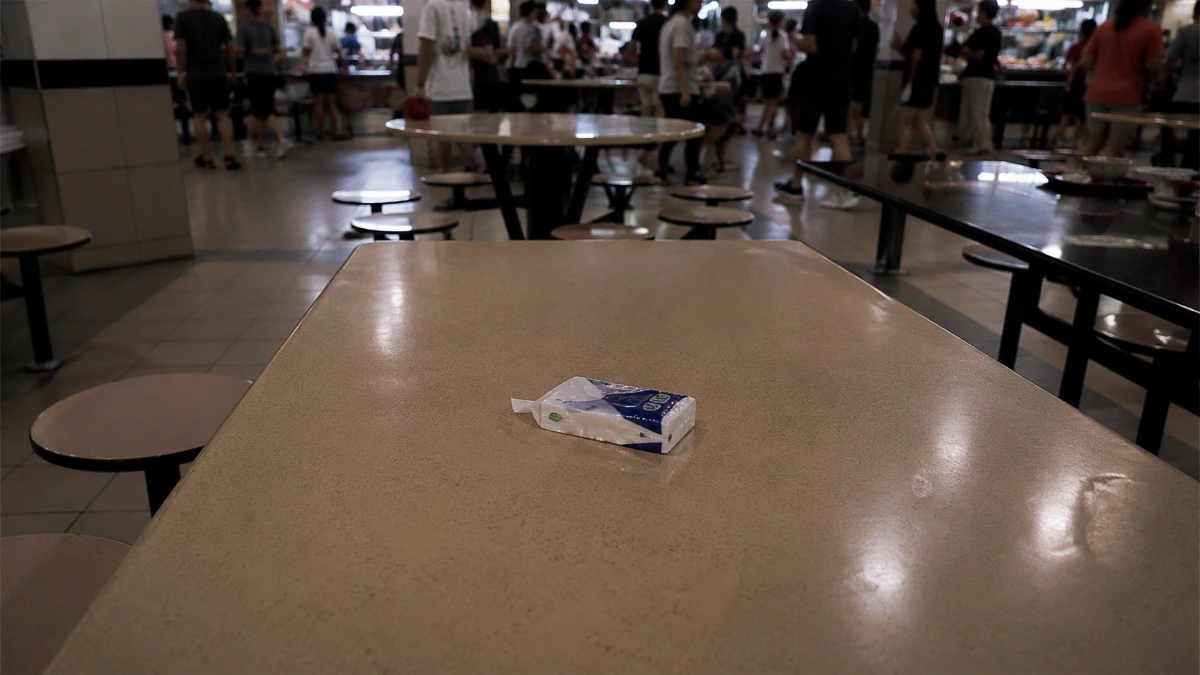
A food court clash erupts when a woman bins a tissue packet, causing a fierce debate on whether objects or physical presence truly reserve a seat.
A PACKET of tissues left on an empty table has become the centre of an online debate, with some viewing it as a valid way to reserve a seat, while others dismissed it as little more than litter.
The seemingly insignificant object has triggered a wider discussion about social etiquette, the use of public spaces and the differences in dining customs between neighbouring countries.
The debate began after a Threads user shared an encounter at a local food court, where she came across an empty table with a packet of tissues placed on it.
According to the user, she threw the tissues away, believing they had been left behind as rubbish rather than as a sign that someone had reserved the table.
The action reportedly led to a confrontation with the stall owner, prompting her to argue that such practices do not apply in Malaysia.
“This is not Singapore; this is Malaysia. To reserve a seat, you must sit on the chair,” she wrote.
The post received support from many Malaysians, who agreed that leaving a packet of tissues on a table should not automatically entitle someone to claim the seat.
One user shared a personal experience of trying to reserve a table with personal belongings but failing to keep it.
“I once placed wet wipes and lip balm on a table while waiting in a long queue. People did not care and simply sat down anyway. That was when I realised there is no ‘chope’ culture in Malaysia,” the user wrote.
Others argued that while table reservation practices do exist, some methods are more acceptable than others.
“I can understand using a tumbler. But a packet of tissues? Come on,” one commenter wrote.
Another user said Malaysians do recognise the concept of reserving seats, but it is usually done through physical presence or more obvious personal belongings.
The discussion also prompted humorous reactions from users who admitted they had misunderstood the practice.
One commenter recalled accidentally using tissues left on what turned out to be a reserved table.
“It explains why the auntie at the next table was glaring at me and my children. I didn’t realise it was a Singaporean way of reserving tables. I even used one of the tissues because I thought it was free,” the commenter wrote.
A Singaporean user also weighed in, questioning the practice of using small items to reserve seats.
“I also don’t understand why people insist on doing this. I once saw someone place a name card on a table, so I threw it away and sat there. The look on their face when they returned was priceless,” the user wrote.
However, some pointed out that the issue is not necessarily about nationality but about differing expectations in shared public spaces.
One commenter noted that food courts generally operate on a free-seating basis unless there is a clear indication that a table has been occupied.
Another user summed up the local sentiment with a simple phrase: “We reserve with our bottoms. No bottom, no seat.”
While some communities accept objects such as tissues, name cards or personal belongings as markers to reserve seats, others believe such items can easily be removed and do not establish ownership of a table.



