




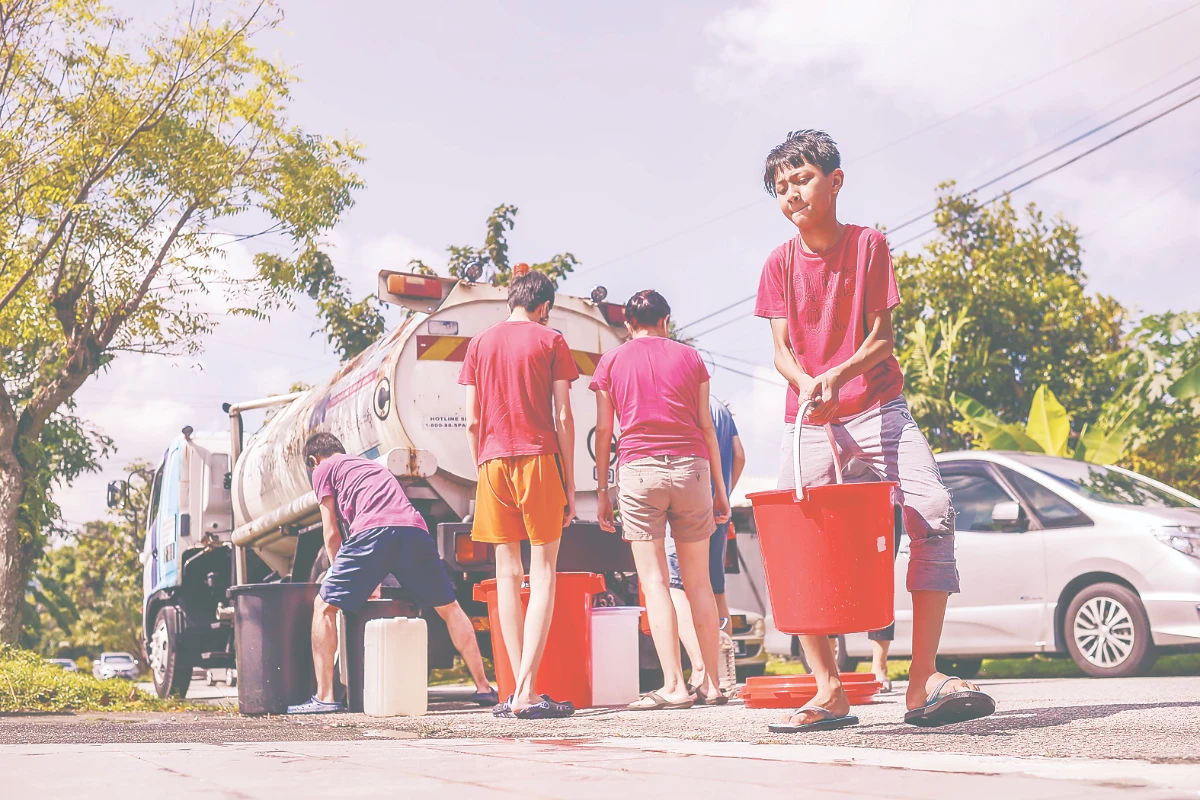
We can no longer view water access as a static development goal to be checked off a list.
FOR decades, the global conversation around water and sanitation has followed a comforting, linear narrative: We are making progress.
More people now have access to clean water than before.
The world is on a path, however slow, to solving this basic human need.
Guy Howard’s critical assessment, “The future of water and sanitation: Global challenges and the need for greater ambition“, shatters this complacency.
His findings are a stark wake-up call – our current approach is not only inadequate but dangerously misaligned with the realities of the 21st century.
We are trying to solve yesterday’s problems with yesterday’s tools while a perfect storm of new threats gathers force.
The central and most devastating finding is this: climate change is unravelling our hard-won gains.
We can no longer view water access as a static development goal to be checked off a list.
A well built today may be dry in a decade due to shifting rainfall patterns.
A water treatment plant on a coastline may be inundated by saltwater intrusion or extreme flooding.
Climate change isn’t a future threat; it is a present-day multiplier of water scarcity, pollution and infrastructural failure.
Our investments are becoming increasingly fragile.
This leads to Howard’s second crucial point: the profound and dangerous inequality in water security.
The article would argue that the divide is no longer just between the global North and South but between the resilient and the vulnerable everywhere.
The wealthy can afford desalination plants, private tanks and adaptive technologies.
The poor are left with contaminated sources, erratic supplies and the brutal consequences – disease, lost education and economic paralysis.
This is not just an issue of justice; it is a recipe for social instability and conflict.
So, what’s holding us back? Howard identifies a critical failure of ambition and a funding gap that is more of a chasm.
But the problem is deeper than money; it is a failure of imagination.
We remain trapped in a siloed mindset: The water-sanitation split – we often treat clean water and safe sanitation as separate issues.
In reality, they are two sides of the same coin.
Inadequate sanitation contaminates water sources, making the provision of clean water infinitely more difficult and expensive.
A holistic approach is not just efficient; it is the only one that works.
The innovation lag: Where is the “Apollo programme” for water? We have seen breathtaking innovation in renewables, computing and medicine but the fundamental technologies for managing water and waste in a sustainable, circular way have not kept pace.
We need a surge of investment in smart water grids, affordable purification and waste-to-resource technologies that recover water, nutrients and energy.
The way forward: From incremental to transformative.
Howard’s call for “greater ambition” is the heart of the matter.
It means building for resilience, not just access.
Every new water and sanitation project must be climate-proofed. This means using climate data to site facilities, designing for drought and flood, and protecting natural ecosystems like wetlands and forests that are our first line of defence.
Embracing the circular economy: We must stop seeing wastewater as a problem to be disposed of and start seeing it as a resource to be mined.
Singapore’s NEWater and other projects show it is possible to close the loop, turning “waste” into clean water, fertiliser and biogas.
Prioritising the poorest and most vulnerable: Ambition means targeting those hardest to reach – not because it is easy but because it is essential.
This requires nuanced, context-specific solutions and a relentless focus on equity.
The conclusion is inescapable.
Achieving universal, safe and sustainable water and sanitation is the bedrock upon which all other development goals – from health and gender equality to poverty reduction and climate action – depend.
Howard’s work shows us that our current trajectory is a path to managed decline.
The question is no longer if we can afford to act with greater ambition but whether we can afford not to.
The future of water is not a pre-determined fate; it is a choice.
We must choose to be as ambitious, innovative and resilient as the challenges we face.
Our collective stability, health and prosperity depend on it.
Prof Datuk Dr Ahmad Ibrahim is affiliated with the Tan Sri Omar Centre for STI Policy Studies at UCSI University and is an adjunct professor at the Ungku Aziz Centre for Development Studies, Universiti Malaya.
Comments: [email protected]



