




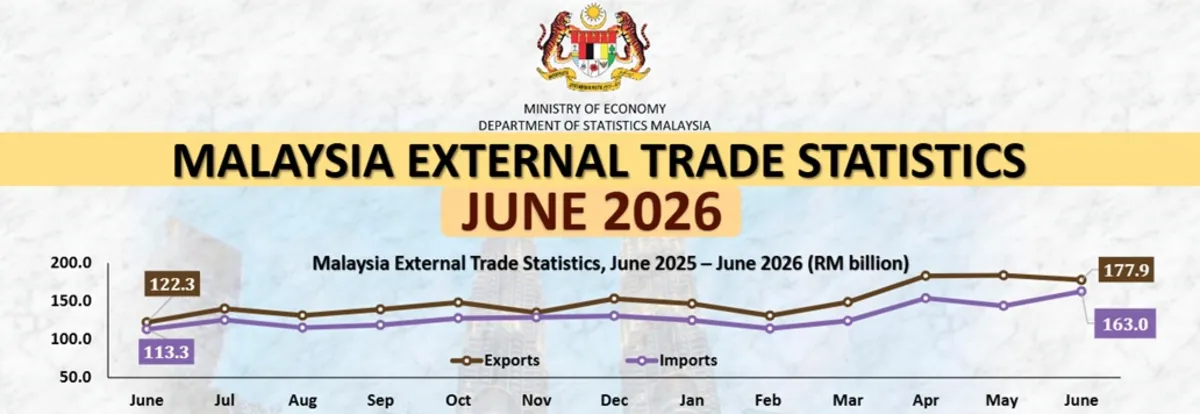
PETALING JAYA: Malaysia’s trade performance continued to strengthen in June 2026, supported by sustained growth in both exports and imports.
Total trade rose by 44.7% from RM235.6 billion in June 2025 to RM340.9 billion last month, driven by stronger growth of exports (+45.4%) valued at RM177.9 billion and imports (+43.9%) amounting to RM163 billion.
In addition, the trade surplus increased by 64.9% to RM14.9 billion in June, the Department of Statistics Malaysia (DoSM) highlighted that Malaysia’s exports increased in June 2026, supported by growth in both re-exports and domestic exports. Re-exports, which accounted for 22.1% of total exports, rose by 48.7% year-on-year to RM39.3 billion. Meanwhile, domestic exports, contributing 77.9% of total exports, expanded by 44.6% to RM138.6 billion. Correspondingly, imports increased to RM163 billion, registering a rise of 43.9%.
The trade surplus increased by 64.9% to RM14.9 billion, marking the 74th consecutive month of surplus since May 2020. Compared with May 2026, imports and total trade increased 13.2% and 4%, respectively.
Meanwhile, exports and trade surplus decreased by 3.2% and 62.7%.
In terms of commodity groups, 162 out of 258 export groups and 193 out of 258 import groups posted gains compared to the same month of the previous year.
DoSM said the rise in exports was primarily underpinned by increased shipments to the United States (+RM18.1 billion), followed by Singapore (+RM8.1billion), China (+RM5.4 billion), Taiwan (+RM3.1 billion), European Union (+RM2.7 billion), Japan (+RM2.6 billion) and Thailand (+RM2.5 billion).
The import rise largely reflected higher inflows originating from China (+RM15.8 billion), followed by Singapore (+RM10.0 billion), South Korea (+RM4.6 billion), United States (+RM4.2 billion), Taiwan (+RM3.5 billion), India (+RM2.2 billion) and European Union (+RM2.2 billion).
Export growth was anchored by heightened shipments of electrical and electronic products (+RM30.9 billion), other manufactures (+RM8.8 billion), petroleum products (+RM4.7 billion), liquefied natural gas (LNG) (+RM2.9 billion), optical and scientific equipment (+RM2.2 billion) and manufacture of metal (+RM2.1billion).
Concurrently, imports corresponded with stronger inflows of electrical and electronic products (+RM32 billion), petroleum products (+RM5.6 billion), other manufacturing (+RM2.1 billion), machinery, equipment and parts (+RM1.8 billion), manufacture of metal (+RM1.7 billion) and transport equipment (+RM1.6 billion).
DoSM also reported that the increase in imports by end-use was driven by strong demand for all three components, namely intermediate goods, capital goods and consumption goods.
Imports of intermediate goods (52.4% of total imports) increased by 41.3% or RM24.9 billion to reach RM85.4 billion. Imports of capital goods (14.8% of total imports) also increased by 67.4% or RM9.7 billion, settling at RM24.2 billion, whereas imports of consumption goods (6.8% of total imports) increased by 17.2% or RM1.6 billion, amounting to RM11 billion compared to June 2025.
In the second quarter of 2026, total trade, exports, imports and trade surplus experienced an increase compared to the same period last year.
The encouraging economic performance led to a 34.1% rise in total trade, aligning with the increase in exports (+42.4%) and imports (+25.4%). The trade surplus amounted to RM84 billion, an increase of 449.2% compared to the same period in 2025.
Total trade, exports and imports for the period of January to June 2026 registered an improvement. Total trade posted a double-digit increase of 22.4%, from RM1.5 trillion to RM1.8 trillion, in line with the rise in exports (+27.5%), as well as imports (+16.9%). The trade surplus expanded by 159.8% to RM147.1 billion.



