




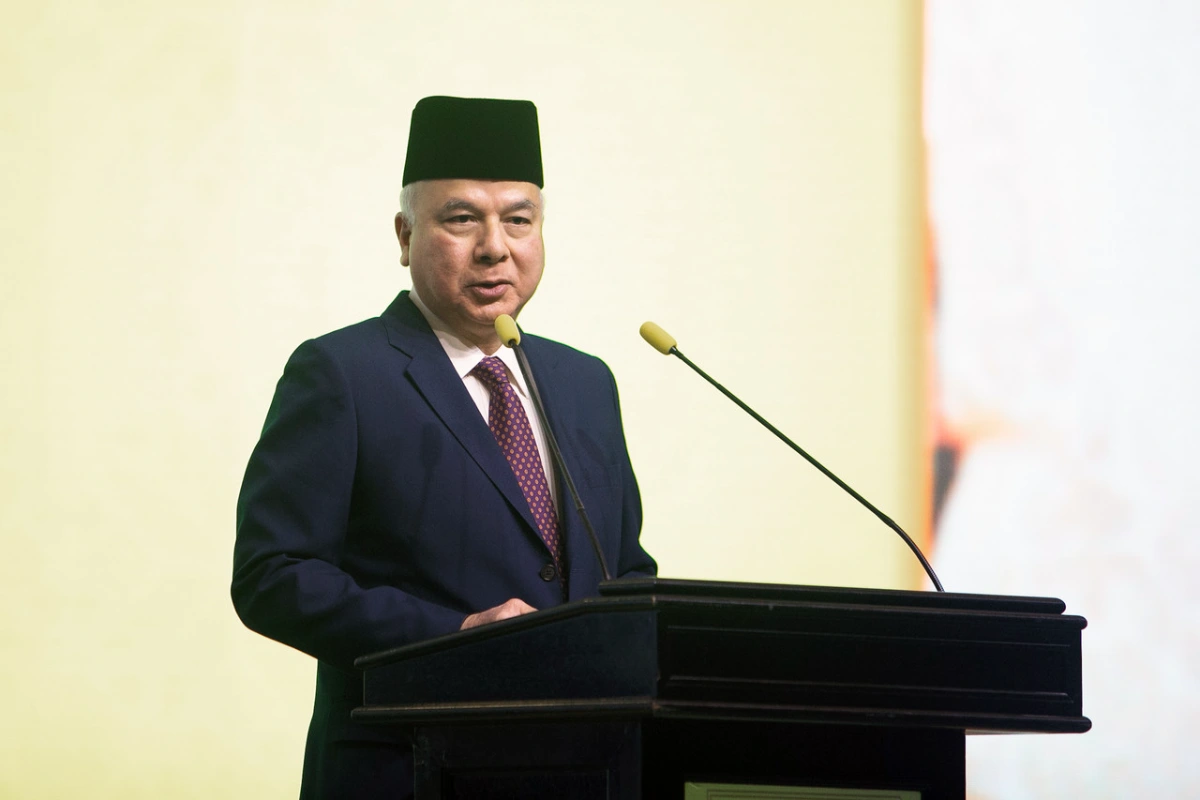
Sultan Nazrin Shah says true national integrity rests on every citizen feeling they have an equal stake in their nation’s future.
IPOH: Defending borders and combating cyber threats or extremism remain essential, but the most durable form of security is social cohesion, said the Sultan of Perak, Sultan Nazrin Shah.
His Royal Highness said for Malaysia and the wider Muslim world, national integrity also demands vigilance against the exploitation of religious sentiment for narrow political ends.
“… the manipulation of faith to justify division rather than unity, exclusion rather than the very inclusion that this conference seeks to advance.
“True national integrity rests on every citizen, regardless of ethnicity or faith, feeling that they have an equal stake in their nation’s future. Where that sense of belonging is absent, no amount of security apparatus can substitute for it,” His Royal Highness said.
Sultan Nazrin said this in his address at the 8th World Conference on Islamic Thought and Civilisation (WCIT): “Everyone Matters: Pride and Unity in Islam” here today.
Also present were Deputy Prime Minister Datuk Seri Fadillah Yusof, who is also the Minister of Energy Transition and Water Transformation, Perak Menteri Besar Datuk Seri Saarani Mohamad and Higher Education Minister Datuk Seri Dr Zambry Abd Kadir.
Sultan Nazrin said a nation’s security cannot be separated from its integrity, as a country that is secure from external threats but riddled with internal corruption and injustice has not achieved true security at all; it has merely postponed its reckoning.
His Royal Highness stressed that national integrity is not maintained by uniformity or by silencing dissent but by ensuring that every community has a genuine stake in the nation’s success.
“… and can see itself reflected fairly in its laws, its economy, its schools, and its leadership.
“Unity built on coercion is brittle, unity built on shared belonging is resilient, and it is precisely this resilience that constitutes the truest form of national security,” Sultan Nazrin said.
On education, Sultan Nazrin said human capital investment is essential to face upcoming challenges such as automation, climate change, and a knowledge-based economy.
This means not only building more schools and universities, but strengthening the sciences and mathematics without neglecting the humanities and the arts; embracing digital literacy while still cultivating the foundational habits of reading, reasoning, and moral reflection.
“… and ensuring that technical and vocational education is given the same dignity and investment as academic pathways, so that a young person who wishes to become a skilled tradesperson is valued as highly as one who wishes to become a doctor or an engineer,” Sultan Nazrin said.
His Royal Highness noted that as the country progresses further into the age of artificial intelligence, the rote memorisation and standardised testing, which served an earlier industrial economy reasonably well, are poorly suited to a world in which information retrieval is instantaneous and nearly free.
“What the young need now is the capacity for critical thinking, ethical reasoning, creativity and adaptability — precisely the human capacities that AI cannot replicate, and precisely the capacities that a properly conceived Islamic education, rooted in both revealed knowledge and rational inquiry, has always sought to cultivate,” Sultan Nazrin said.



