



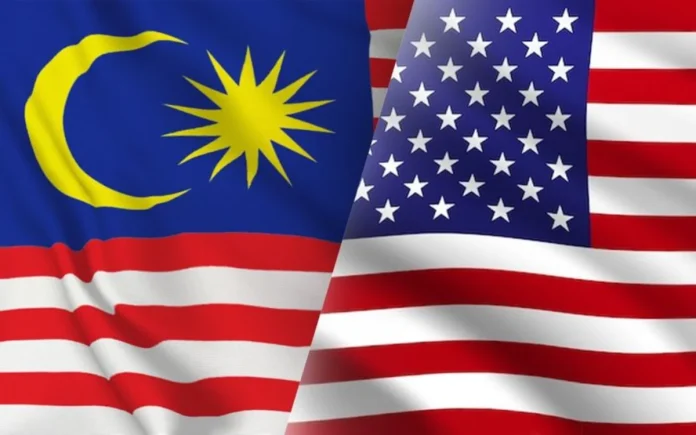
Economist warns that reopening the Malaysia-US trade agreement risks protectionism and could deter investment, despite calls for a review to protect national interests.
PETALING JAYA: Malaysia’s exposure to United States tariffs under the Malaysia–United States Agreement on Reciprocal Trade (ART) has already been substantially reduced, making a review or renegotiation unnecessary, said an economist, even as others argue that the pact compromises broader national policy interests.
Dr Geoffrey Williams said Malaysia secured significant tariff exemptions under the agreement and reopening negotiations could imply that the original talks were poorly handled by the then Investment, Trade and Industry minister Tengku Datuk Seri Zafrul Aziz.
Citing data from CGS International Securities Malaysia Sdn Bhd, Williams said 62.8% of Malaysian exports to the US were exempted from tariffs when measured by actual export value, after more than 2,000 tariff lines relevant to bilateral trade were zero-rated or abolished by both sides.
This reduced Malaysia’s effective exposure to US tariffs to just 4.6%.
“This is one of the best exemption performances in Asean,” he told theSun.
He added that Malaysia also reduced tariffs on 6,911 products under the agreement, improving the overall tariff regime for both countries.
Williams said renegotiating the ART signals a return to “protectionist policies”.
“This does not help Malaysian businesses or consumers. It helps only vested interests,” he said, adding that such a move could discourage trade and foreign direct investment.
He also questioned the emphasis on small and medium enterprises (SMEs) in discussions surrounding the ART, arguing that SMEs are largely domestically focused due to the nature of their products and services.
“Furthermore, SME development falls under other ministries, not Miti, so this would be a duplication of effort,” he said.
Malaysia’s total trade nearly doubled from RM1.2 trillion in 2015 to RM2.2 trillion in 2024.
However, SME contribution to GDP rose only marginally over the same period, from 37% to 39%.
Newly appointed Investment, Trade and Industry Minister Datuk Seri Johari Abdul Ghani said Malaysia may want to review its trade agreements with the United States and renegotiate any terms found to be unfair.
In his inaugural speech at the ministry on Dec 17, Johari cited uneven economic indicators, particularly those involving SMEs, as a reason for reassessing trade arrangements.
He said agreements already signed could not be reversed, but provisions deemed inequitable could be identified for renegotiation.
In contrast, Emir Research president and CEO Datuk Dr Rais Hussin Mohamed Ariff supports a review of the ART, arguing that the agreement “extends beyond conventional tariff facilitation” into wider policy domains.
“The agreement, while framed as reciprocal, reaches deeply into Malaysia’s regulatory, fiscal, digital, industrial and security architecture. The small gain in tariff of about 6% does not commensurate with what we have to let go.”
Rais also pointed out that the US market accounts for only about 4.2% of the global market, referring to its population of roughly 348 million compared with an estimated global population of 8.2 billion.
“With about 60% of its population living paycheque to paycheque and more than 80% receiving some form of government financial assistance, this points to weak disposable income,” he said, adding that Malaysia must diversify its trading partners.
He further cautioned that Malaysia should not lose sight of its policy of active neutrality, Asean centrality and the World Trade Organisation’s consistent non-discrimination stance, warning that the ART could place the country in a bilateral alignment that contradicts its neutral position.
“Clause 7.3 of the agreement should be invoked without delay and structured negotiations undertaken to realign this agreement with Malaysia’s sovereign and developmental priorities.”
Rais added that agreements of this magnitude require rigorous legal scrutiny, economic impact assessments and parliamentary oversight.



