




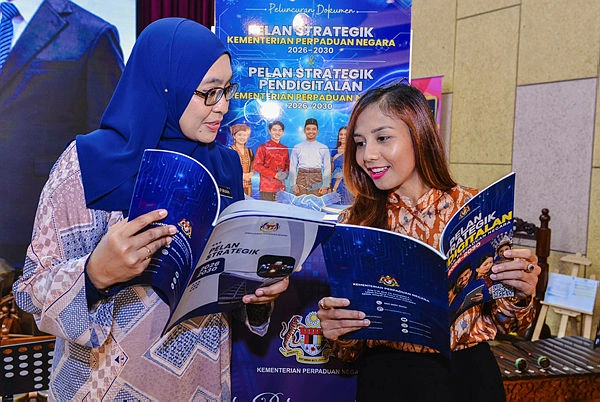
The Ministry of National Unity unveils five-year strategic and digitalisation plans to strengthen national values and social integration.
KUALA LUMPUR: The Ministry of National Unity (KPN) today launched two strategic plans as key reference documents to set the ministry’s direction for the next five years in its efforts to build a nation-state.
Its Minister, Datuk Aaron Ago Dagang, said the first plan, the KPN Strategic Plan 2026-2030, aims to strengthen national values, reinforce social integration foundations and preserve heritage assets as pillars in nation-building.
The second plan, the KPN Digitalisation Strategic Plan 2026-2030, is a planning document developed to support the digital transformation agenda.
“The KPN Strategic Plan 2026-2030 comprises five core areas, 12 strategies and 33 initiatives, which will be implemented in phases throughout the 2026 to 2030 period.
“It is aligned with the aspirations of Malaysia MADANI, and the ministry’s mandate under the 13th Malaysia Plan (13MP), which is on nation-building as the foundation for sustainable national unity,” he said at the KPN monthly assembly and the launch of the plan here.
Aaron said that as an enhancement, the KPN Strategic Plan 2026-2030 also introduces the Policy Impact Assessment (PIP) approach, which will serve as a key instrument to monitor the implementation of operational plans and measure the achievement levels of each core area, strategy and initiative more effectively.
“This will ensure every action taken delivers a clear impact on the nation-building and national unity agenda,” he said.
According to Aaron, the KPN Digitalisation Strategic Plan 2026-2030 encompasses three main focus areas outlining various programmes, projects and digitalisation initiatives in line with organisational needs and current technological developments.
He also urged the Department of Museums Malaysia (JMM) make full use of the RM5 million Museum Matching Grant (GPM) 2026 to accelerate modernisation and digitalisation efforts in the country’s museum sector, including through the use of artificial intelligence (AI) technology.
He said the grant, provided by the MADANI Government, aims to support museum development and upgrading projects through broader strategic collaboration between museum institutions and government-linked companies (GLCs), the private sector and the corporate community.
“In developed countries such as the United Kingdom, corporate collaboration models with museums have long been practised, including the establishment of digital learning spaces such as the Samsung Digital Discovery Centre through a partnership between Samsung and The British Museum.
“Such models should be explored in Malaysia so that more companies can come forward as strategic partners in preserving and elevating the country’s heritage for future generations,” he said.



