




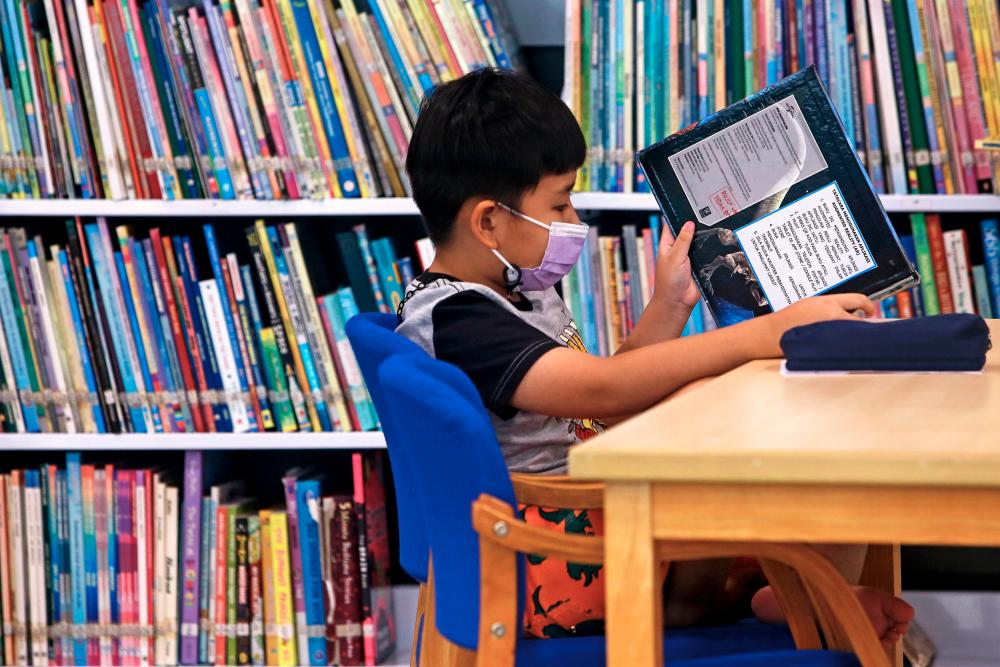
PETALING JAYA: Malaysians have little interest in reading books because electronic media appeals more to the senses, said Teach For Malaysia (TFM) research, design and impact manager Sawittri Charun.
TFM is a proponent of quality education and a partner of the Education Ministry and the Global Education Network.
Sawittri told theSun that to ascertain why Malaysians were not prolific readers, a good starting point would be to ask if one finds reading books to be entertaining and if one is curious enough to read books to learn something new.
“For reading to become a habit, it needs to fulfil one or both of two purposes, which is entertainment and information gathering.
“Avid readers either enjoy following the ups and downs of characters in books they are reading or have a great sense of curiosity to know and learn more through books.”
Sawittri said for information gathering, one can also satisfy this need by just doing some quick searches on the internet, or using artificial intelligence supported apps.
“The need to pick up a book, printed or electronic, has moved down the order of preference.”
She said TFM has been building a transformational movement in the education system by placing the country’s most promising graduates and young professionals as full-time teachers in some of the country’s “most difficult schools”.
She said this helps to combat education inequity through its flagship leadership development programme, called “Fellowship”.
“In 2020, we expanded our work as the implementation partner of the two-year nationwide ‘Program Duta Guru’ (PDG), as well as training and coaching in-service public school STEM teachers.”
TFM is a 2022 Merdeka Award recipient under the Education and Community category. The award is Malaysia’s premier recognition for excellence founded by Petronas, ExxonMobil and Shell in 2007.
“Since our launch in 2012, our movement of 473 fellows, 583 PDG teachers and alumni has impacted 330,285 students in 893 schools across the country.”
Sawittri said the pandemic had exacerbated the problem of poor reading skills among students, leaving many who have not developed the basic skills needed for them to enjoy reading.
“We are committed to making the development of literacy a high-value component of our fellowship programme.
“In their pre-service training, our fellows are trained on the foundation of literacy and on evidence-based strategies to teach reading and writing to struggling readers and writers.”
She said the lack of engaging, accessible reading material for students at the primary level is one of the challenges.
“In the early years, beginner readers could benefit from a wide range of easy-to-read books, with rich visuals to support comprehension.
“For many of the students we work with, the school library is the main source of reading material. But very few schools have sufficient collections of age-appropriate and visually-engaging reading material.”
Meanwhile, Malaysian Council of Professors senior fellow Datuk Dr Jeniri Amir told said people are obsessed with social media and attracted to Facebook and Instagram.
“I have collected 11,000 books since 1997, with various genres such as language, literacy, social, politics and social science. Children these days are exposed to social media more than reading. I read at least four books per week and children these days would not even open a book.”
Jeniri said people who do not read could have low thinking skills and poor knowledge on understanding of the world.
“Readers usually read not only in one field but many to gain more knowledge and better thinking skills.
“For example, those who are in science not only read science-related books but also books on others such as geography and politics.”



