



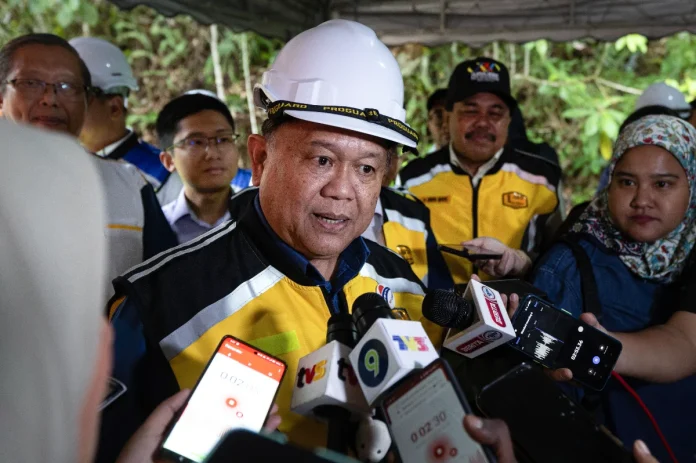
Works Ministry allocates emergency funds to repair hybrid power systems in 43 flood-hit rural schools
KUCHING: Works Minister Datuk Seri Alexander Nanta Linggi (pic) announced today that RM30 million in federal funds has been earmarked specifically for urgent repairs to hybrid-electricity generation facilities damaged across 43 schools throughout Sarawak.
The minister made the announcement during a visit to Sekolah Kebangsaan Lubok Bedil in the Katibas state constituency in central Sarawak, one of the many educational institutions grappling with flood damage that has disrupted both power supply and normal operations.
The approved funding targets a critical vulnerability exposed by the recent flooding: the hybrid-solar electricity generation systems that many rural Sarawak schools depend on for power have sustained extensive damage, leaving students and educators without reliable electricity.
“The repair works in these 43 schools are urgently needed as the hybrid-solar electricity generation facilities have been badly damaged by the floods since last year,” Nanta explained, emphasising the immediate nature of the infrastructure crisis.
These hybrid-solar systems represent significant investments in bringing reliable power to remote areas where grid connectivity remains limited or non-existent. Their damage doesn’t merely inconvenience—it fundamentally disrupts educational delivery in communities already facing geographic and infrastructural challenges.
The affected schools are concentrated primarily in remote constituencies across central Sarawak, with Kapit and Song districts experiencing particularly severe impacts.
Nanta, who serves as the Member of Parliament for Kapit, has firsthand knowledge of the challenges facing these communities. The geographic isolation that characterizes much of interior Sarawak means that infrastructure damage creates compounded difficulties—repairs take longer, replacement parts must travel greater distances, and temporary alternatives are harder to implement.
For schools in these areas, hybrid-solar electricity systems aren’t luxuries but necessities that enable basic educational functions from lighting classrooms to powering computers and other learning technologies increasingly essential to modern education.
The Works Ministry is moving quickly to translate approved funding into actual repairs. Nanta confirmed that contracts for the repair work packages are currently being arranged, suggesting the bureaucratic groundwork is already underway to get contractors mobilised.
This expedited approach recognises that each day schools operate without proper electricity compromises educational quality and places additional burden on teachers and students who must adapt to inadequate facilities.
The urgency becomes particularly acute as the academic calendar continues—prolonged infrastructure failures mean prolonged educational disruption for students in affected schools, potentially widening achievement gaps between rural and urban students.
The flooding’s impact extends beyond electrical systems. Nanta revealed that prolonged inundation has caused physical damage to school building infrastructure itself—structural issues that require separate attention and funding.
“There are also physical damages to the infrastructure of school buildings caused by the prolonged floodings,” the minister noted, adding that repair packages for these structural issues are also being evaluated.
This suggests the total cost of flood recovery for Sarawak’s educational infrastructure will exceed the announced RM30 million, with additional allocations potentially forthcoming once structural damage assessments are completed.
Building damage from prolonged flooding can include foundation weakening, wall deterioration, floor damage, compromised roofing, and mold growth—all issues that pose safety risks and create unhealthy learning environments if not addressed promptly.
The funding announcement comes as Sarawak continues experiencing active flooding, with fresh flash floods reported in multiple districts on the same day as Nanta’s school visit.
The Sarawak Fire and Rescue Department documented flash flooding in low-lying areas across southern and northern Sarawak, with ground reports from stations in Lundu, Bau (both in southern Sarawak), and Limbang (in northern Sarawak) indicating numerous villages experienced flooding Sunday morning.
Riverine regions—areas along rivers that are particularly vulnerable to overflow during heavy rainfall—saw especially significant flooding impacts.
Sarawak has endured continuous flooding challenges since early December 2025, as monsoon rains have battered the state repeatedly over more than six weeks.
This prolonged nature of the flooding distinguishes the current crisis from typical flash flood events. While individual flood episodes may recede within days, the cumulative impact of repeated inundation over weeks creates compounding damage as infrastructure never fully dries out or recovers before the next flood arrives.
For schools, this means that even facilities that initially weathered early flooding may have deteriorated progressively as water repeatedly damaged electrical systems, saturated building materials, and stressed structural elements.
Understanding the significance of the RM30 million allocation requires appreciating the role hybrid-solar electricity systems play in Sarawak’s rural education landscape.
Many interior Sarawak schools serve communities far from electricity grid infrastructure. For decades, such schools either operated without reliable power or depended on diesel generators—expensive, noisy, polluting, and requiring constant fuel delivery to remote locations.
Hybrid-solar systems combine photovoltaic panels with battery storage and often backup generators, creating self-sufficient power solutions that can operate independently from the grid. These systems enable:
- Consistent lighting for classrooms regardless of weather or time of day
- Computer and technology use essential for modern curriculum delivery
- Internet connectivity through powered networking equipment
- Administrative functions including record-keeping and communication
- Improved learning environments with fans, adequate lighting, and powered educational aids
When flooding damages these systems, schools don’t merely lose convenience—they lose fundamental capabilities that define contemporary education.
The federal funding allocation demonstrates coordination between national and state governments in addressing disaster impacts.
While education falls under state jurisdiction in Malaysia’s federal system, infrastructure funding often involves federal support, particularly for disaster recovery that exceeds state budgetary capacity.



