




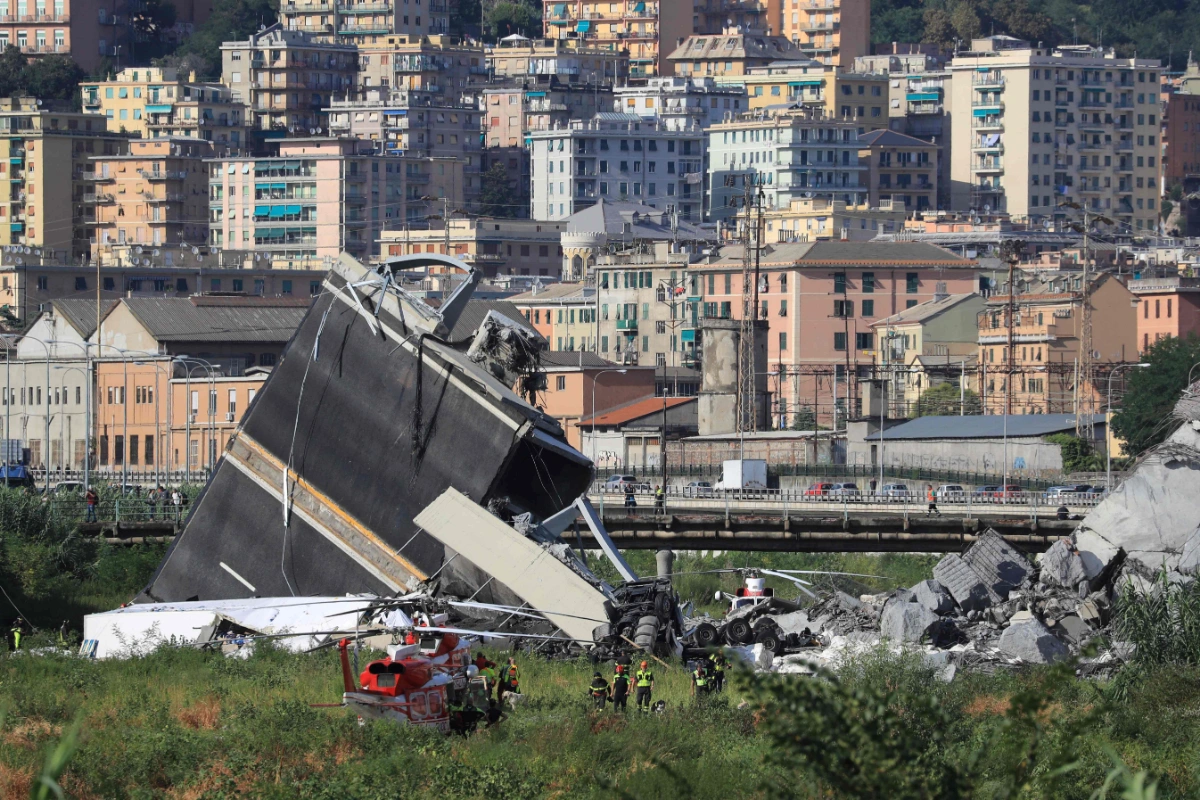
Italian court to rule on the 2018 Morandi Bridge collapse that killed 43, ending a trial over one of Italy’s worst disasters
GENOA: An Italian court is set to deliver a verdict Thursday in the case of a bridge collapse nearly eight years ago that killed 43 people in one of the country’s worst infrastructure disasters.
Relatives of victims and dozens of media outlets were at the hearing at the court in Genoa, where the Morandi Bridge — part of a key highway connecting France and Italy — gave way in torrential rain on August 14, 2018.
Its collapse sent dozens of vehicles and their passengers tumbling into the abyss.
Thursday’s verdict comes after four years of trial hearings for 57 defendants on charges of manslaughter, endangering transport safety and falsifying official documents.
The prosecution has requested jail sentences adding up to more than 400 years in total.
Egle Possetti lost her sister, nephew, niece and brother-in-law when pillar nine of the bridge collapsed.
A conviction “won’t bring them back”, she told AFP.
“But clearly the most important thing for the victims is that the truth finally comes out,” said Possetti, who heads a committee of victims’ relatives.
During the years-long trial, “not a single person has said, ‘I bear some responsibility.’ That has been hard,” Possetti said as she walked into court Thursday.
A verdict is expected after 1200 GMT.
‘Ticking time bomb’
The findings of the magistrates’ investigation are damning: “Between the inauguration in 1967 and the collapse, i.e. 51 years later, not even minimal maintenance work was carried out to reinforce the stays of pillar number 9”.
Work had been carried out on two other pillars, numbers 10 and 11, and was planned for number nine.
Prosecutor Walter Cotugno dubbed the bridge “a ticking time bomb”.
Most of the defendants are executives and technicians from Autostrade per l’Italia (ASPI), which runs almost half of the country’s motorway network, and engineering company Spea, in charge of maintenance.
They include the general manager of Autostrade at the time, Giovanni Castellucci, the former head of Spea, Antonino Galata, and officials from the infrastructure ministry.
Castellucci is accused of postponing work on pillar number nine and risks 18 years in prison.
The defence’s main argument is that the bridge had a hidden construction defect, namely corrosion of its cables, and it was this that caused its collapse, not a lack of maintenance.
Castellucci is already serving time for his role in a 2013 accident in which a bus crashed through the barriers of a viaduct, killing 40 people.
Even though their former directors are on trial, Autostrade and Spea reached an out-of-court settlement with the public prosecutor’s office, which provides for a payment of 29 million euros ($30 million) to the state.
At the time of the tragedy, Autostrade belonged to the Atlantia group, controlled by the wealthy Benetton family, but faced with popular indignation the family subsequently gave up its stake to the state.



