




IT began, again, with a tweet. Donald Trump, from his digital podium, declared that Iran and Israel had “come to him” asking for peace and that he was promising a future of “love, peace and prosperity”.
The post went viral. Commentators scrambled. Headlines reframed. But beneath the performance lay the more troubling reality: real peace is nowhere in sight and never was.
Just hours after this so-called peace overture, Israel unleashed another wave of airstrikes.
Yet, we already know Israel’s operations are routinely underwritten by US logistics and satellite support.
Emir Research has long highlighted this conceptual bifurcation within the US, now increasingly visible even to the most unscrupulous observers.
On one side, a political class desperate to appear in control; on the other, a war economy that no longer answers to democratic oversight.
These bombings expose not only Israeli aggression but also the extent to which Washington has become operationally fragmented.
But perhaps the most revealing element is not the gap between Trump’s rhetoric and reality but the possibility that this gap is intentional.
What if Trump’s apparent incoherence is not a miscalculation but a method?
His declarations of peace are routinely followed by orchestrated escalation.
Not because he controls outcomes but because he wants the world to see that he does not.
The deeper message is strategic: that America cannot guarantee anything because it cannot even govern itself.
Treaties signed today are disavowed tomorrow. Not that we did not know this before but with Trump the exposure becomes grotesque.
Trump’s theatre serves a darker purpose: to collapse the perception of US reliability.
His actions – whether on foreign entanglements, tariffs or climate withdrawal – teach the world that American leadership is structurally incoherent. The chaos is not accidental; it is a form of exposure.
And this is not lost on foreign capital. Even long-time allies now quietly ask: If the American state cannot ensure internal coherence, how can it offer global stability? If its wars continue without presidential oversight and its treaties collapse with each administration, what does it mean to be aligned with Washington?
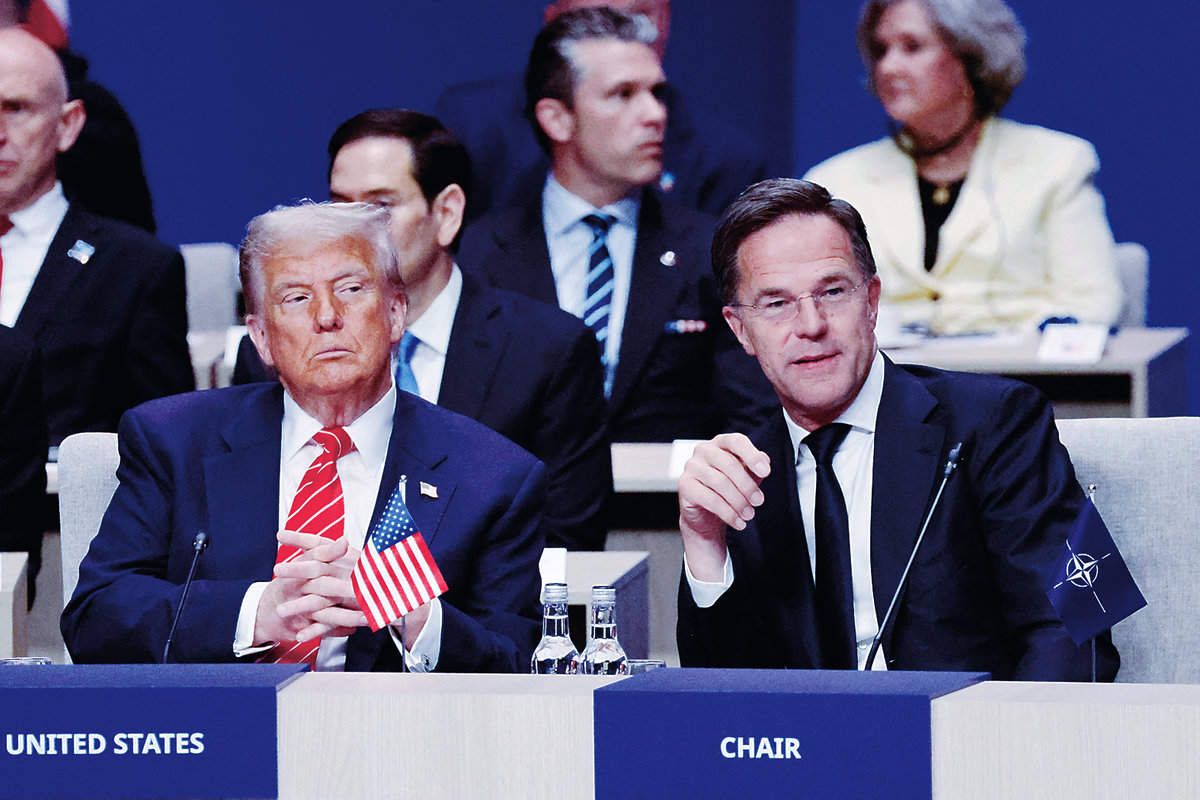
It is in this disillusionment that real geopolitical recalibration begins. While bombs fell and tweets spiralled, the Nato summit convened with all the theatre of importance but none of the coherence.
Once a cornerstone of postwar Western security, the alliance now resembles a museum exhibit: elaborate, well-lit but out of time.
South Korea’s absence was not a matter of disengagement. As reported by the South China Morning Post, it reflected a pragmatic diplomatic recalibration.
Across the Global South, Nato is viewed increasingly as a relic: obsessed with 2% defence spending while the world burns from climate shocks, cyber threats, pandemics and migratory collapse.
Even Nato members struggle to meet its goals. Reuters reports only a few are on track for the 2% target by 2025.
The rest offer rhetoric, not readiness. Yet, rather than recalibrating, Nato has now endorsed a new goal of 5% defence spending by 2035. This shift reflects more about worldview than actual threat.
Many in the Global South are asking: Containment of what, exactly? Is Nato defending the world or defending its relevance?
The problem is not just strategic. It is existential. Nato’s core logic – big-state militarism, fixed enemies, endless deterrence – is ill-suited to a world of decentralised threats and non-linear crises. The alliance now projects the image of an inward-looking bloc.
Across Latin America, Africa and Asia, new coalitions are forming around infrastructure, energy resilience, digital sovereignty and climate action. These are not military alliances but post-Western lifelines.
If Nato wants to remain relevant, it must shift from fortress to forum. So far, the signs are unconvincing.
Something deeper is unfolding behind the theatrics of war and summits: a realignment not of blocs but of meaning.
Across countries, the question is no longer whom to side with but whether the old story still holds at all. Take Iran.
Its administration is probably far from universally embraced, even domestically. But its refusal to collapse under sabotage, sanctions and psychological warfare has turned it into a symbol of dignity under siege.
From South Africa to Indonesia, Pakistan to Latin America, solidarity with Iran stems not from ideology but from memory. It comes from a shared experience of being coerced, demonised, dehumanised and denied narrative parity.
Across Africa, Southeast Asia and parts of Latin America, political leaders and civil society voices increasingly point to a common view. Iran is not being punished for aggression but for independence.
The pattern is familiar: covert interference, sanctions and media vilification. These pressures mirror what many postcolonial nations face for refusing alignment with dominant powers. What the Global South is registering is a declaration of strategic sovereignty.
In this climate, Malaysia has found its own voice.
It does not project force or fund proxy wars. What it offers is narrative clarity. Through consistent diplomatic positioning, Malaysia has argued that peace without accountability is a false peace.
Israel’s nuclear ambiguity, Western impunity and the systematic erasure of Palestinian dignity are no longer seen as unfortunate contradictions.
They are becoming untenable pillars of a collapsing order. In this emerging terrain, narrative is the new front line.
The Global South is no longer waiting for permission. It is reframing what dignity, deterrence and diplomacy mean in a world unmoored from Western centrality.
What we are witnessing is not just a contest of weapons but a reckoning of words. The old order relied on language to mask contradiction. Today, those words no longer conceal. They expose.
The Nato summit only magnified irrelevance. Its metrics, even if not false, are out of sync with the world’s pulse.
Climate collapse does not ask for battalions – nor does a broken food system or digitally displaced generation.
As for the US, the facade of unity has never looked thinner. It is no longer a singular actor but a split organism – one hand tweeting peace, the other fuelling war. This is not a strategy; it is entropy.
And in the margins of this collapse, a new world is taking shape. Multipolar networks are forming not through grand treaties but through quiet refusal. These actors refuse to be lectured, intimidated or ignored.
If a new system emerges, it will not be born in Cold War summits or Nato declarations.
It will be built on the courage of coherence and on the dignity of those once silenced who are now speaking in full.
The Global South, long treated as an audience, is now writing its own script.
Dr Rais Hussin is the founder of Emir Research, a think tank focused on strategic policy recommendations based on rigorous research. Comments: [email protected]



