




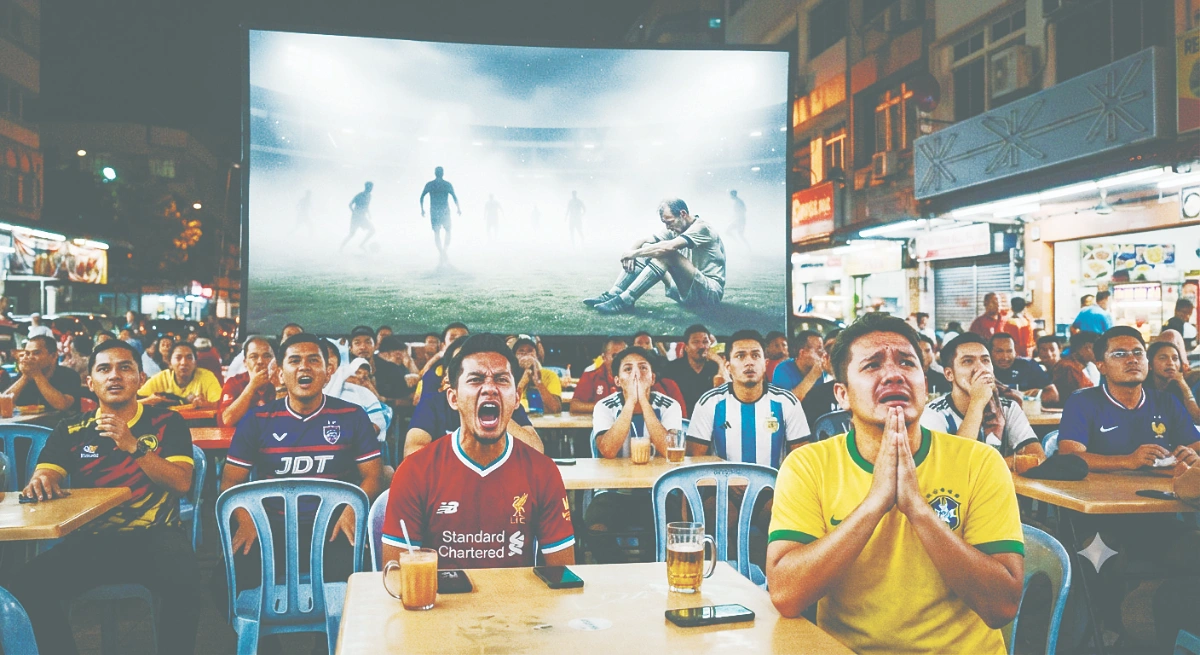
The World Cup’s supernatural pull unites fans and ghosts in a beautiful game of hope, memory and fleeting glory.
IT’S football!! That beautiful, beautiful game with its profound ability to unite cultures worldwide. But what has it got to do with ghosts, spirits and the supernatural? Lots. Just think about it.
Every World Cup has ghosts. No, not the sort that rattle chains, haunt abandoned houses or drift across moonlit cemeteries. But it has its regular cast of characters. The die-hard fan who plans his sleep around kick-off times.
The self-appointed referee who disagrees with every decision. The friend who suddenly develops an encyclopaedic knowledge of South American football despite barely following the local league.
Then there are the rest of us. We drift in and out of matches, learn a few new names every four years and cheer because everyone else is cheering. We are football’s friendly ghosts or ghouls – appearing briefly, haunting the tournament for a month, before quietly disappearing until the next World Cup.
It is perhaps the only sporting event capable of convincing millions of perfectly sensible adults that they possess supernatural powers. For instance, some refuse to change seats because their team scored while they were sitting there.
Then there are fans who will not answer the telephone, fearing that even a brief conversation could somehow interrupt “the momentum”. If that is not belief in ghosts, it comes remarkably close.
For one month, normal life quietly steps aside for the World Cup. Coffee shops and mamak restaurants become séance rooms of another kind, where strangers gather nightly to summon hope from 90 minutes of football.
They celebrate like lifelong teammates after a dramatic goal. People who insist they have little interest in football somehow know every score before breakfast. Entire rooms gasp in unison when a penalty is missed, then fall into a silence so complete that even the clatter of teaspoons sounds unusually loud.
The morning after, reality returns – reluctantly. Some faithfully report for work despite surviving on barely two hours of sleep.
Others mysteriously develop a “fever” that lasts precisely one working day. A few are said to forget to call in sick until lunchtime, when the alarm finally reminds them they were supposed to be unwell. Such is the power of football.
Sometimes, however, devotion comes with a sobering reminder that passion has its limits. Almost every tournament brings reports of supporters collapsing from the sheer emotional strain.
One fan suffers a stroke while watching a match. Another does not survive a heart attack after the final whistle.
It is a reminder that while football is only a game, the emotions it awakens are very real.
Then there’s another curious ritual – the predictions. Of course, predictions are not inherently supernatural, but come the World Cup, suddenly everyone becomes a football oracle.
Office pools spring to life. Family WhatsApp groups become tactical war rooms. People who cannot remember where they left their car keys confidently predict the semi-finalists weeks in advance.
Even those who barely know the offside rule somehow find themselves placing friendly wagers on who will lift the trophy.
The World Cup itself begins with 48 nations and millions upon millions of dreams.
By the knockout stages, the tournament has acquired another invisible audience – the ghosts of eliminated teams, shattered predictions, busted office pools and supporters already insisting that “next time” will be different.
Perhaps that is why the World Cup feels supernatural. Every four years, it reminds us not only how the game changes, but how we do.
The child watching wide-eyed beside his father today may be watching alone when the next tournament comes around. Friends gather once more around the same table, only to notice that one familiar chair is empty this time.
Four years pass far more quickly than we imagine. There is something bittersweet about that. The World Cup doesn’t just crown champions – it measures our own lives in four-year chapters.
By the time the third-place playoff kicks off in the early hours of today and the final crowns a new champion before dawn tomorrow, another chapter will already be drawing to a close. The predictions will be forgotten – especially the spectacularly inaccurate ones. Life will return to normal. Until four years later.
As for this year’s champion?
Conventional wisdom points towards Spain. Yet tournaments have always had a soft spot for unexpected heroes, and sometimes the team that slips almost unnoticed through the shadows is the one still standing when daylight arrives.
Just ask Portugal. In the past, it went quietly about its business with the confidence of a team that knew it need not shout to be heard. But this time, it was eliminated after a 1-0 loss to Spain.
This year, the final quartet – Spain, France, Argentina and England – felt like a fitting cast. Each was just two matches from football immortality. If you had asked four people who they thought would win, chances are you would have received four different answers.
That, perhaps, is what makes the World Cup so special. Statistics and predictions point one way, hope another, but all of that can be swept aside by one brilliant goal, one inspired save or sometimes the penalty shootout.
Tomorrow, one nation will celebrate. The others will reflect on what might have been. But whichever team lifts the coveted trophy, this World Cup will once again remind us why, every four years, billions of people happily lose sleep for the beautiful game.
Perhaps that is what haunts us. Not the matches we lost, but the moments we can never watch again with the people who once sat beside us.



