




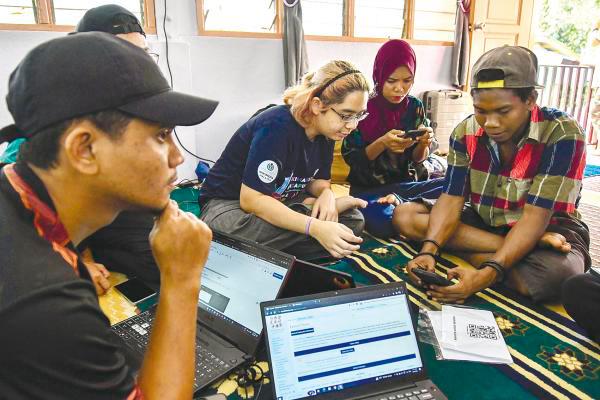
GUA MUSANG: Her round eyes peering at her mobile phone, Ida Terang seems unperturbed by her noisy surroundings, her fingers swiftly typing on the screen.
The 33-year-old religious education teacher has a new mission now, which is to prevent her mother tongue, the Mendriq language, from sinking into oblivion.
Ida is among 20 villagers from the Mendriq Orang Asli community in Kampung Kuala Lah – about 180km from Kota Bharu – who are involved in a project to input Mendriq words and their meanings in Bahasa Melayu onto the online multilingual dictionary Wiktionary.
The brainchild of Wikimedia Community User Group Malaysia (Wikimedia Malaysia), the initiative is aimed at preserving the Mendriq language.
Wikimedia Malaysia organised a two-day programme in Kg Kuala Lah in October to input as many Mendriq words as possible onto Wiktionary.
The Mendriq are a minority subgroup under the Negrito Orang Asli group (which is one of the three main Orang Asli groups in Peninsular Malaysia, the other two being Senoi and Proto-Malay).
Over the years, it became increasingly challenging for the Mendriq elders to preserve their ancestral language as their tribe is dwindling in size with only about 600 of them left now. All of them are living in Kelantan in three locations – Kg Kuala Lah in Gua Musang and Kg Pasir Linggi and Sungai Tako in Kuala Krai.
Another reason for the low usage of the native language is the younger generation’s preference for the Kelantanese Malay dialect. They are simply more comfortable speaking in the local Malay dialect.
Language experts interviewed by Bernama previously said the Mendriq language could become extinct in 20 years if no serious efforts are taken to preserve it.
Ida and her fellow villagers who took part in the two-day workshop – facilitated by 18 Wikimedia Malaysia and Islamic International University Malaysia (IIUM) volunteers – were not exactly smartphone-savvy but when it ended, they successfully listed a total of 340 Mendriq words and 107 audio pronunciations on Wiktionary.
Some of the older villagers chose to jot down the words they knew on pieces of paper, while their children or grandchildren helped to type them on their phones.
“I’m so happy (to be a part of the project) because I don’t think there are people out there interested in preserving our language.
“This step (making Mendriq a part of Wiktionary) will not only allow our language to be accessed by our community but also by people around the world,” Ida, a mother of two, told Bernama, adding the online Mendriq dictionary can become a source of reference for future generations as well.
She also said having participated in the two-day programme, she can now share her knowledge with other members of her community and help them to input even more words.



