




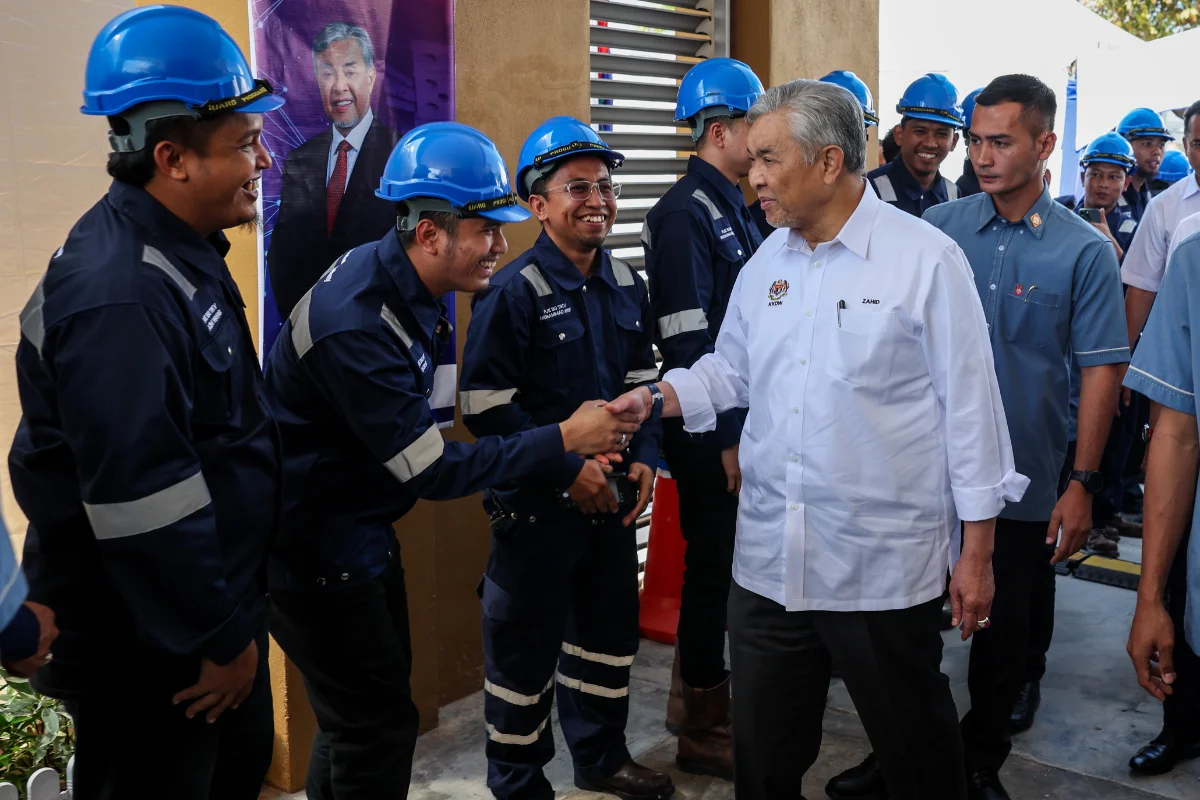
Deputy Prime Minister Ahmad Zahid Hamidi announces the rebranding of 25 MARA institutes to TVETMARA, aiming to strengthen technical education and widen student pathways.
TASEK GELUGOR: All MARA Skills Institutes (IKMs), MARA Higher Skills Colleges (KKTMs) and the MARA-Japan Industrial Institute (MJII) have been rebranded as TVETMARA.
Deputy Prime Minister Ahmad Zahid Hamidi said this reflects the government’s commitment to elevating technical and vocational education and training (TVET) as a national priority.
The rebranding involves 25 institutions and aims to strengthen the new technical education ecosystem under MARA.
It is designed to open wider pathways for students in the skills field.
Ahmad Zahid explained that TVETMARA is open to students from various backgrounds.
This includes Sijil Pelajaran Malaysia (SPM) leavers, GiatMARA and vocational college graduates.
“The education pathway under TVETMARA is organised according to skill levels,” he said.
He detailed that GiatMARA offers Malaysian Skills Certificate (SKM) Levels 2 and 3, while Levels 4 and 5 will be under TVETMARA.
Graduates can then choose to further their studies at Universiti Kuala Lumpur for bachelor’s, master’s and PhD programmes.
They also have the option to enter the job market with relevant professional qualifications.
He added that even those without a pass in SPM have the opportunity to enhance their careers in TVET.
Collaboration with industry players has boosted graduate marketability to 98.7%.
The marketability rate for graduates of the former IKM institutes has reached 100%.
The government hopes the rebranding will maintain these achievements and expand opportunities for higher education.
A key goal is to support the national need to produce 60,000 engineers in the electrical and electronics field.
In tandem with the rebranding, the Seberang Perai Utara IKM will transform into the National Electrical Energy Specialist Academy (NEST).
This transformation will follow a strategic plan for the 2025-2035 period.
Ahmad Zahid said the NEST framework aligns with two main development phases focusing on community, industrial and national development.
The implementation is activated through four main focus areas supported by five core strategies.
It encompasses 29 strategic initiatives driven by eight key catalysts.



