




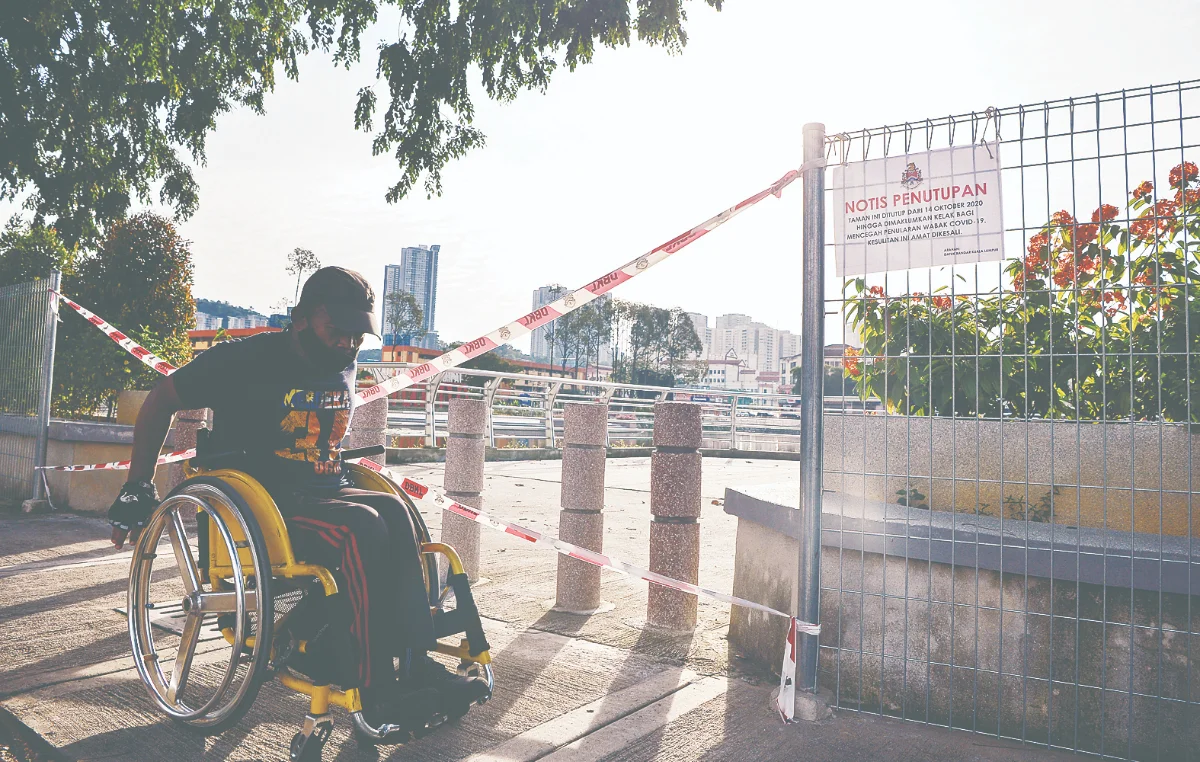
Accessible pedestrian networks reduce traffic congestion, encourage public transport use, lower accident rates, promote healthier lifestyles and enhance tourism.
EVERY day in Kuala Lumpur, thousands of Malaysians step out of their homes unsure whether they will reach their destinations safely.
For persons with disabilities, older persons, parents with strollers and even children, a simple walk can quickly turn into a dangerous obstacle course.
Uneven pavements, missing kerb ramps, obstructed pathways, dead-end walkways and tactile blocks that abruptly stop are not isolated defects; they are common features of the urban environment. These are not minor inconveniences – they are design and governance failures that expose people to injury, force them into traffic and exclude them from full participation in society.
Recent calls by civil society groups to establish a committee on walkability, universal access and connectivity in Kuala Lumpur are therefore timely and justified.
However, for such a panel to deliver real improvements, it is important to first address a foundational issue: Are we facing a lack of standards or a gap in implementing the standards that already exist?
Malaysia is not short of standards. We already have established Malaysian Standards, such as MS 1184 on universal design and accessibility in the built environment, MS 1183 on fire safety provisions for persons with disabilities and MS 1331 on access to outside buildings. These are aligned with international frameworks, including the UN Convention on the Rights of Persons with Disabilities (UNCRPD) and ISO 21542 on accessibility and usability of the built environment.
Collectively, they emphasise continuity, safety, usability and dignity across the entire pedestrian journey – not just at building entrances.
Yet on the ground, accessibility is too often treated as a box-ticking exercise rather than a system. A kerb ramp may exist but it leads to a broken sidewalk. Tactile paving may be installed but it ends abruptly at a pole or drain.
A walkway may appear compliant on paper but becomes unusable halfway through. These failures reflect not a lack of technical guidance but weak adoption, fragmented responsibility, inconsistent enforcement and the absence of systematic auditing.
The scale of the issue demands attention. As of March 31, 2025, Malaysia has 767,243 registered persons with disabilities. This figure alone represents a substantial segment of the population whose safety and independence depend on functional pedestrian infrastructure.
It is also widely acknowledged that under-registration means the real number is higher. When combined with Malaysia’s rapidly ageing population, the number of people affected by unsafe and inaccessible walkways already runs into the millions.
International experience across Commonwealth cities, such as London, Melbourne and Singapore, reinforces the importance of a standards-led approach. Their progress did not come from forming panels in isolation but from embedding accessibility standards into planning approvals, procurement processes and maintenance regimes, supported by regular, independent audits and transparent public reporting.
Panels, where they exist, function as implementation and oversight mechanisms, not advisory bodies detached from standards.
This is why putting standards first matters. By mapping existing Malaysian standards and international benchmarks before establishing a panel, the government can define a clear and credible mandate – one focused on implementation, monitoring and accountability rather than policy duplication. Such an approach prevents policy fatigue, strengthens institutional coordination and ensures that recommendations translate into measurable outcomes on the ground.
Framed this way, a walkability and universal access panel becomes a solution, not a symbol. Importantly, walkability is not only a disability issue. Accessible pedestrian networks reduce traffic congestion, encourage public transport use, lower accident rates, promote healthier lifestyles and enhance tourism.
More fundamentally, they reflect cities designed for safety, dignity and inclusion for all. Standards already exist. Best practices are well documented.
By putting standards first, Malaysia can ensure that walkability and universal access move from well-intentioned commitments to safer streets and more liveable cities. Accessibility works best when standards lead the way.
Saral James Maniam
Secretary General
Malaysian Association of Standards Users
Affiliate of Federation of Malaysian Consumers Association



