




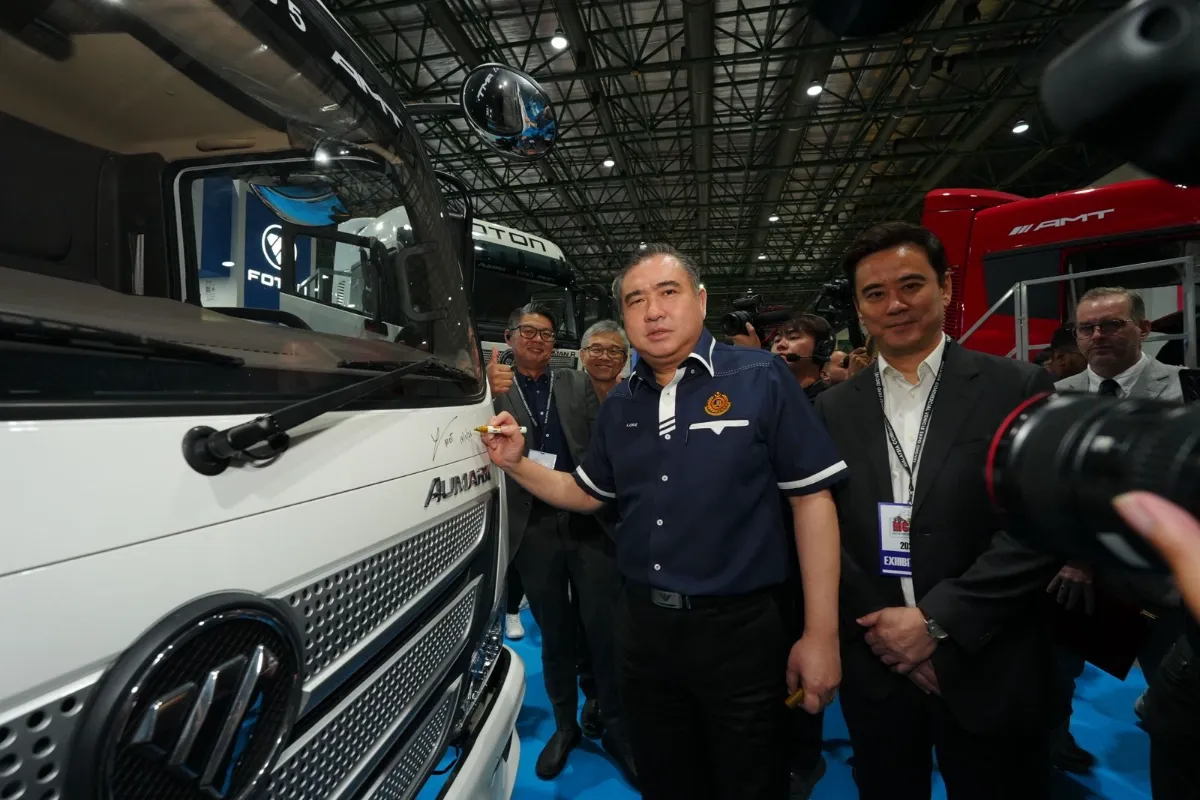
KUALA LUMPUR: Malaysia is studying incentives to accelerate electric vehicle truck adoption as the government grapples with the country’s diesel subsidy bill exceeding RM2 billion a month and rising pressure to decarbonise commercial transport ahead of its 2050 net-zero target.
Transport Minister Anthony Loke Siew Fook said the government is shifting part of its EV policy focus towards commercial vehicles after several years of concentrating primarily on passenger EV adoption.
“Under the current circumstances, does the government have enough funds to improve commercial transport? We are currently spending more than RM2 billion a month on diesel subsidies,“ he told reporters at the Malaysia Commercial Vehicle Expo 2026 in Kuala Lumpur today.
Loke said the government is examining various forms of incentives, including tax incentives, to reduce the cost of purchasing EV trucks, which remain significantly more expensive than conventional diesel-powered commercial vehicles.
“The reality today is that an EV truck costs two to three times more than a conventional truck. This makes the transition difficult for many operators,“ he said.
According to Loke, EV truck adoption in Malaysia remains extremely limited, with fewer than 10 units currently operating nationwide, mostly on a trial basis by transport companies. “Much of the commercial vehicle industry is still transitioning towards Euro 5 diesel standards, with EV trucks remaining far from mainstream adoption in Malaysia.”
Loke acknowledged that charging infrastructure remains one of the biggest barriers to wider EV truck adoption.
“If we want to encourage EV truck adoption or EV vehicle usage generally, there must be a comprehensive ecosystem in place, especially in terms of charging stations. That remains a major challenge for our country at the moment,“ he said.
Loke said the government believes the transition towards commercial EVs is unavoidable in the long term as Malaysia moves towards its net-zero emissions target by 2050, despite the challenges.
“Whether we like it or not, many sectors, including transportation, must find ways to reduce emissions across every field and sector,“ he said.
Loke said countries such as China have already moved aggressively to mainstream EV truck adoption as part of efforts to reduce reliance on diesel fuel and improve transport efficiency. “In China, it has already become mainstream because the Chinese government wants to encourage EV truck usage to reduce dependence on diesel fuel.”
However, he stressed that Malaysia’s transition would require a more gradual and pragmatic approach given current infrastructure limitations and the financial realities faced by transport operators.
Loke said the government is studying incentive mechanisms and developing a broader EV ecosystem that could eventually support commercial fleet electrification at scale.
He added that the government also wants EV growth to support domestic industrial development through greater localisation and completely knocked down vehicle assembly in Malaysia.
“We want to move towards greater EV adoption, but at the same time, we also want to develop the local industry,“ he said.
Loke said the current subsidy mechanism has remained stable and continues to support most essential commercial transport activities. “Most commercial vehicles, especially those transporting containerised goods and covered cargo, continue to receive subsidised diesel prices.”
Rising global fuel prices could eventually make it harder for the government to sustain broad diesel subsidy mechanisms indefinitely, particularly as Malaysia balances fiscal constraints with its long-term decarbonisation commitments, the minister said.
While diesel-powered trucks still dominate the local market and EV truck adoption remains in its early stages, he said Malaysia must start building the infrastructure, policies, and industry ecosystem needed to support future electrification efforts.
“We need to start taking steps to see how our country can move towards EV truck adoption in a way that is more resilient and competitive,“ he said.
The Malaysia Commercial Vehicle Expo returns for its seventh edition this year, featuring its largest international participation to date, with overseas exhibitors increasing their presence at the three-day exhibition held at the Mines International Exhibition and Convention Centre.
The event features several new entrants, including Angka-Tan Motor, JAC Motors, Trucks Dotcom and Handal BCM, alongside returning exhibitors such as Allegiance Malaysia, which occupied the largest exhibition space this year.
Malaysia Commercial Vehicle Expo 2026 also introduces several firsts, including its inaugural country pavilion featuring seven Taiwanese companies, while the Association of Malaysian Hauliers hosted industry-focused Coffee Talks covering topics such as AI readiness, rebuilt trucks and road safety.
Singapore-based LogiSYM is anchoring its CargoNOW logistics conference alongside the exhibition.



