




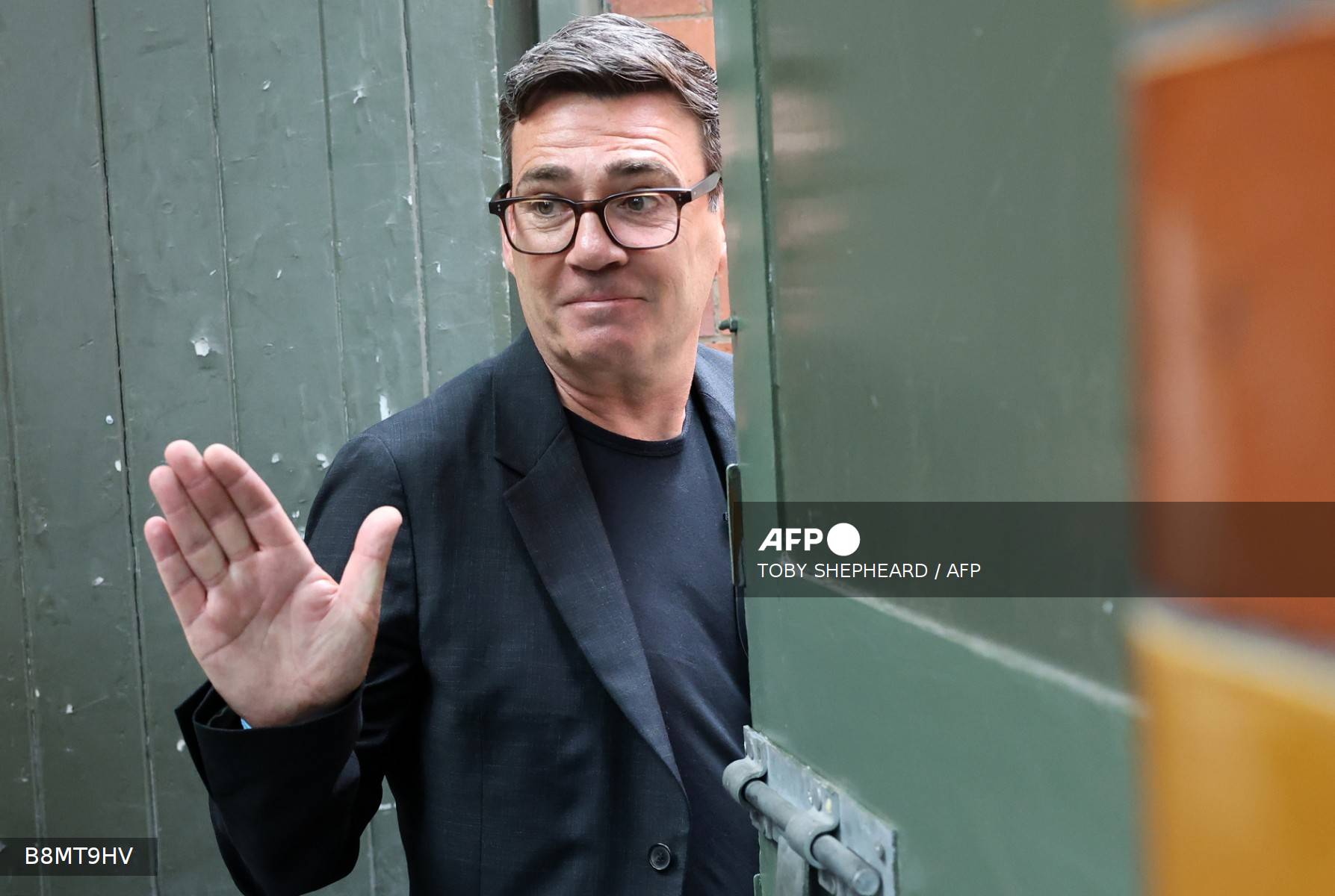
Andy Burnham’s mayoral success faces a sterner challenge as he prepares to lead Britain from a weakened national position.
MANCHESTER: When Andy Burnham left Britain’s parliament in 2017 to become Greater Manchester’s first elected mayor, few would have predicted his return within a decade to be prime minister.
A government minister in the 2000s who twice lost centre-left Labour Party leadership contests, Burnham, 56, found political rejuvenation and the perfect springboard for his ambition in the thriving northwest English city-region.
“He played a good hand well,” Henri Murison, chief executive at The Northern Powerhouse Partnership think tank, said of Burnham’s mayoral tenure.
“The question is… how does he play a bad one?” he asked, referring to Britain’s gloomier national picture of high debt, squeezed finances, sluggish growth and poor productivity.
On Friday, Burnham will vanquish the ghosts of his past to become ruling Labour’s new leader. He will replace outgoing Prime Minister Keir Starmer at 10 Downing Street on Monday.
He has vowed to devolve powers to other cities and create a “No. 10 North” based in Manchester to ensure regions outside the British capital are not neglected.
But Burnham’s apparent bid to emulate Manchester’s decades-spanning transformation from post-industrial wasteland to economic success story may not survive contact with Britain’s rigid national governing culture.
“This is a harder test than he had in Greater Manchester,” said Murison.
‘Dysfunctional government’
Some question whether Burnham even played a meaningful role in the city-region’s revival, and has the skillset to deliver seismic change.
Greater Manchester — home to three million people — is several decades into a long-term project to boost public and private sector investment through entrepreneurial local governance and various data-led strategies, collaborations and innovations.
Home to two world-famous football teams, five major higher education institutions and a highly profitable airport part-owned by the regional government, its burgeoning skyline is testament to its turnaround under so-called “Manchesterism”.
Under 2016 reforms that created the mayoralty, Burnham headed the Greater Manchester Combined Authority but shared power in devolved policy areas like transport with the elected leaders of the city-region’s 10 boroughs.
That meant he was mostly just “one of 11 votes” and more like “the captain of a football team,” noted journalist and author Andy Spinoza, whose 2023 book “Manchester Unspun” charts its 40-year resurrection.
“He’s had to be collaborative, and people talk about that as being his superpower when really, it’s a basic prerequisite of the job.”
Less than 1,000 people lived in the city centre in the early 1990s, compared to more than 100,000 now, explained Philip McCann, professor at the Manchester-based Productivity Institute.
“Walk around… the changes are phenomenal,” he told AFP.
With Manchester, he and others credit the “visionary leadership” of Howard Bernstein, the city council’s unelected chief executive from 1998 to 2017, and Richard Leese, its elected leader for 25 years from 1996.
McCann argued Burnham has been “both a custodian and an accelerant” of their agenda.
Working in Greater Manchester required power-sharing and “long-term thinking”, Leese told AFP.
“That’s not the way that Westminster works,” he added.
“But not only did he learn a new way of working, he now wants to take that new way of working and try and apply that to a central government that’s frankly been dysfunctional for decades.”
‘Momentum’
For Spinoza and others, Burnham’s achievements have been overstated.
“The part that he’s played is both being in the right place at the right time,” he said. “He’s an agile politician who’s seen this opportunity and Manchester’s given it to him.”
Burnham’s most visible policy success was bringing the previously fragmented, privately run bus system back under public control within an integrated transport network.
He is also credited with trying to broaden economic activity geographically.
“His political skill has created this kind of momentum and legitimacy around a Greater Manchester idea,” Joshi Herrmann, founder of local journalism start-up Mill Media, told AFP.
However, Burnham took office vowing to end rough sleeping in the city by 2020 and failed.
Matthew Johnson, homeless charity Lifeshare’s chairman, lauded him for raising the problem’s profile and showing “genuine care”.
But he noted “homelessness remains a huge issue” and views the failure as symbolic of something bigger.
“We dreamt of becoming like London, and that’s what we’ve managed to do — we’ve created a more unequal city space.”
Burnham endured other setbacks, including attempting to impose a clean air zone on drivers that ended up a costly failure.
McCann is nonetheless “delighted” the ex-mayor is taking power after having “lived and breathed” devolution during a period in which the UK government has become increasingly open to it.
“It almost feels like this is the real big bang now,” he said. “I am optimistic”.



