




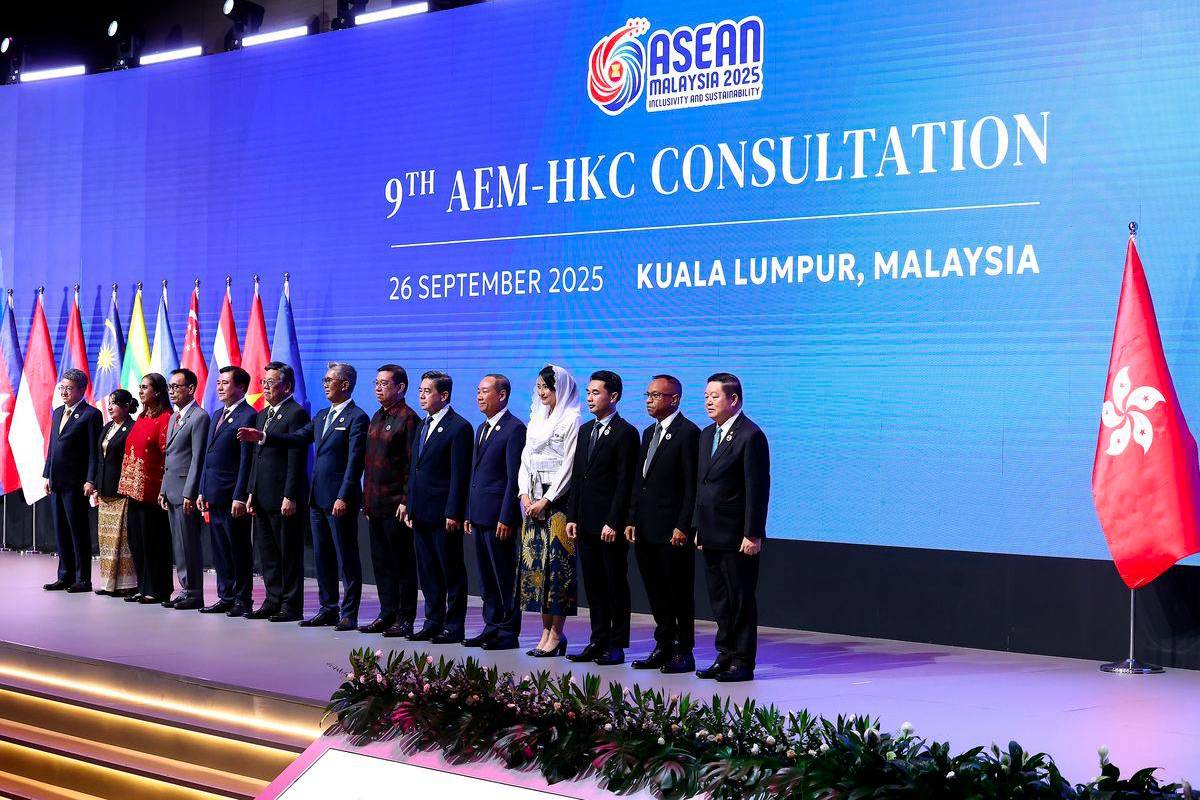
KUALA LUMPUR: Southeast Asian economies have sent a clear message that their markets are open for business, despite being confronted by tough protectionist measures and tariffs that threaten free trade and stoke immense global uncertainty.
Credit is due to Investment, Trade and Industry (MITI) Minister Tengku Datuk Seri Zafrul Abdul Aziz, who, as the ASEAN Economic Ministers (AEM) chair, emerged as the man of the hour — galvanising unity and keeping the AEM meetings firmly focused on deepening regional integration, despite external distractions from those flouting multilateral trade rules.
ASEAN’s single-minded focus is to become the world’s fourth-largest economic bloc by 2030, despite shifting geopolitical dynamics — a goal that underscores the futility of retaliating against economic superpowers like the United States, as such actions are unlikely to benefit any party.
Areas covered by what is surely a highly successful AEM include “good progress” on the 18 Priority Economic Deliverables (PEDs), upgrading the ASEAN Trade in Goods Agreement (ATIGA), digital cooperation and a commitment to support capacity-building programmes to strengthen Timor-Leste’s entry into ASEAN as a formal member at the ASEAN October Summit.
Tengku Zafrul deftly handled more than 20 meetings and engaged constructively with 10 fellow ASEAN countries as well as 11 dialogue partners for five full days, leading the grouping in resisting trends towards market fragmentation.
But it was not all smooth sailing, as even before the 57th (AEM) Meeting and Related Meetings with dialogue partners, which ended today, the US imposed additional tariffs on pharmaceuticals.
ASEAN, however, was unfazed, preferring to be proactive in dealing with such impediments rather than retaliate.
Feedback from major powers, including the US itself and China, to emerging players such as Chile and Bangladesh, which were not even present in Kuala Lumpur but watched proceedings closely, made it clear that ASEAN is increasingly proving to be a lucrative and strategic economic region.
There was active engagement with dialogue partners comprising the US, China, Russia, Japan, South Korea, Australia, New Zealand, India, the European Union, the United Kingdom, Switzerland, Canada, and Hong Kong.
The discussions underscored ASEAN’s balancing act in navigating rising protectionism and unilateral measures while keeping its markets open and competitive.
US Trade Representative (USTR) Jamieson Greer commended both Tengku Zafrul and Malaysia’s chairmanship in ASEAN’s efforts to strengthen supply chains and expand market access.
Following a bilateral meeting, Tengku Zafrul confirmed that Malaysia and the US aim to conclude tariff talks before President Donald Trump visits Malaysia in October.
“These five days have been constructive, with ASEAN ministers engaging partners from across the globe. Despite differences in views, we all agree that trade and investment must continue to flow,” Greer told Bernama.
Growing interest in ASEAN
Dialogue partners acknowledged that ASEAN is now an indispensable node in global supply chains.
China, Japan, and South Korea reaffirmed their commitment under the ASEAN Plus Three framework, pledging deeper cooperation in semiconductor supply chains, digital trade, green growth and regional financial stability.
Trade with the trio reached US$1.2 trillion last year, nearly a third of ASEAN’s total, while their foreign direct investment accounted for almost 20 per cent of inflows.
Interest in ASEAN’s flagship trade pact — the Regional Comprehensive Economic Partnership (RCEP) — is also expanding.
Hong Kong, Sri Lanka, Chile and Bangladesh signalled their intent to join the RCEP, with ministers urging the accession process to be accelerated.
ASEAN, along with China, Japan, South Korea, Australia and New Zealand, also agreed to a review of the RCEP to keep it relevant in a fast-changing global economy.
Malaysia’s chairmanship deliverables
Hosting ASEAN’s fifth chairmanship since 1977, Malaysia steered several key deliverables. Among them were the conclusion of negotiations to upgrade the ATIGA, aimed at pushing regional integration to a higher level, and the establishment of the ASEAN Supply Chain Coordination Council (ASCCC) to enhance resilience under the ASEAN Manufacturing Network.
Preparatory meetings reported progress on 15 of Malaysia’s 18 PEDs.
A major milestone awaits the ASEAN Leaders’ Summit in October, when the upgraded ASEAN-China Free Trade Agreement (ACFTA 3.0) is expected to be signed.
Another achievement was the signing of the ASEAN Framework Agreement on Competition (AFAC), reflecting the bloc’s intent to promote a fair, rules-based business environment as it builds toward a future-ready single market.
On the external front, ASEAN and Canada reported steady progress in negotiations for a free trade agreement (FTA), targeted for conclusion next year. Canada said the deal would strengthen investment ties and support both sides’ goals of growth and diversification.
The AEM-USTR Consultation, meanwhile, reaffirmed support for closer collaboration between ASEAN and the US-ASEAN Business Council, particularly in the digital economy.
ASEAN is also advancing the Digital Economy Framework Agreement (DEFA), due to be signed next month, which is projected to double the region’s digital economy to US$2 trillion by 2030.
Similarly, Switzerland expressed interest in strengthening ties with ASEAN and hinted at taking a closer look at regional pacts such as the Comprehensive and Progressive Agreement for Trans-Pacific Partnership (CPTPP) and the RCEP.
Anwar’s call for leadership
At the AEM Gala Dinner, Prime Minister Datuk Seri Anwar Ibrahim urged ASEAN to show leadership in the face of global challenges.
He called on ministers to strengthen supply chains, empower micro, small and medium enterprises (MSMEs), invest in sustainability and embrace innovation.
Anwar also underlined the significance of Timor-Leste’s expected admission into ASEAN by the end of October, describing it as a milestone that would deepen regional unity and reinforce ASEAN’s relevance.
Earlier in the week, ASEAN Secretary-General Dr Kao Kim Hourn met Timor-Leste’s Commerce and Industry Minister, Filipus Nino Pereira, to discuss the country’s accession to ASEAN economic agreements in preparation for its full membership by 2025.
What lies ahead
Looking ahead, ASEAN is set to finalise several key agreements at the October summit, including ACFTA 3.0, the upgraded ATIGA and the ASEAN-India Trade Inclusion Agreement.
ASEAN and the CPTPP will also hold their first formal dialogue in November, while South Korea confirmed that an upgraded ASEAN-Korea Free Trade Agreement will be announced next month.
The Kuala Lumpur meetings have reinforced the message that ASEAN is determined to strengthen its resilience while pivoting toward knowledge-driven and value-added growth in a world increasingly marked by uncertainty and fragmentation. – Bernama



