



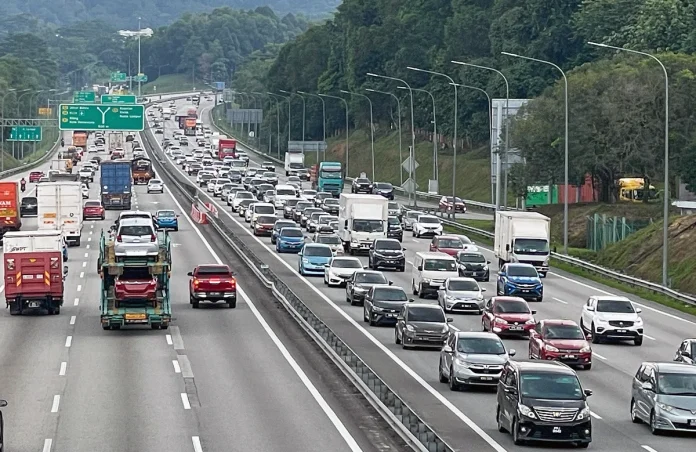
Being stuck in traffic jam compounds frustration, rendering tendency to drive fast after bottleneck: Expert
PETALING JAYA: While minor crashes may still occur during heavy congestion, speeding after traffic clears could turn otherwise survivable collisions into fatal ones during festive travel periods, said the Malaysian Institute of Road Safety Research.
Its chairman Prof Dr Wong Shaw Voon said prolonged congestion often leaves drivers tired and frustrated, increasing the temptation to speed once motorists have cleared the bottleneck stretch.
“At low speeds, collisions may still happen, but they are unlikely to cause death or serious injury. The real danger comes when traffic clears and drivers start speeding to make up for lost time.
“That is when the consequences become severe and irreversible. We can repair vehicles, but we cannot reverse the loss of life or permanent injury.”
He also cautioned motorists to exercise extra care when driving near heavy vehicles, such as lorries and trailers.
“Many drivers assume that if they can see a lorry, the lorry driver can also see them. But that is often not the case. Blind spots exist because of the structure of the vehicle, not because the driver is not paying attention.
“Blind spots are particularly extensive at the rear and left side of heavy vehicles. This makes it dangerous for motorists to follow too closely or remain alongside these vehicles as the driver may not be able to see them at all.
“The larger the vehicle, the larger the blind spot. This creates serious risks not only for motorcyclists, but also for car drivers.”
Wong reminded drivers to maintain adequate following distance at all times, warning that tailgating significantly reduces reaction time.
As a general road safety guideline, motorists are advised to ensure an adequate distance from the vehicle in front to allow sufficient braking time to avoid a collision, in relation to the speed at which they are driving.
He stressed that careful journey planning is more important than travel timing, urging motorists not to rush their journeys despite festive commitments.
“Drivers should plan their journeys properly and make sure they are in good condition before starting. Many people rush to complete their work before a long holiday.
“They push themselves to meet deadlines so that nothing happens while they are away, and by the time they start their journey, they are already tired.
“Someone who normally drives a short distance daily may suddenly be driving for eight hours. That alone increases the risks.”
Wong also highlighted the dangers of unfamiliar road environments during balik kampung trips, adding that road layouts, junctions, traffic patterns and local driving habits may have changed since a driver’s last visit.
“Even if you grew up in a place, you may now return only once or twice a year. Roads change, traffic changes and people’s behaviour changes.”
On Dec 19, the Malaysian Highway Authority announced a 50% discount at toll plazas nationwide for four-wheeled private vehicles, except at the Sultan Iskandar Building toll plaza on the North–South Expressway (PLUS) and the Tanjung Kupang toll plaza on the Malaysia–Singapore Second Link.
The initiative came after the authority anticipated traffic congestion, which it estimated at about 2.6 million vehicles daily during the Christmas period, with the PLUS group’s expressway network alone expected to handle about 2.2 million vehicles.
Highways expected to experience heavy traffic include the Kuala Lumpur–Karak Expressway with 186,000 vehicles, East Coast Expressway Phase One with 69,200 vehicles, Phase Two with 33,200 vehicles and the West Coast Expressway with 144,600 vehicles.



